Top eight ... gonna write as I watch and take some pix off the tube. Danny Gokey, 1980, sings Mickey Gilly's Stand by Me. He's murdering this thing ... missing notes, and the same earnest rasp. The judges always seemed to like him, but he is a one note orchestra to me. And so earnest. Yeah he's got rhythm, but that was just a routine day in a dumpy bar. There's something about this guy that really annoys me ... but the judges all seemed to like it. Harummph.
 Kris Allen, 1985, All She wants to Do is Dance. I thought that was flat and uninteresting, and it just missed the deep tones of his voice that makes him so fascinating. Really boring after the way he blew us away the last couple of weeks. That said, he is the sexiest thing this year by a long shot. Simon hated it. He'll survive, but that was disappointing.
 Lil Rounds, 1984, What's Love Got to Do with It. She's showing a little more voice, but this song is so much bigger than her that it puts her in a shadow. I think she underperforms every week, and it is very disappointing. Because you figure that under there somewhere is a breakout performance. This one is not that one. Competent, but not nearly big enough. Even Paula agrees. Simon was meaner but exactly right. We're still waiting, Lil.
 Anoop Desai, 1986, True Colors. Those big brown eyes, and a voice you can hardly remember. Not ridiculous or anything, but nothing special. Straining a little at times. I just don't care. Randy says a nice vocal, but still "so what"? Simon seemed to like it, and notes that "we can be horrible to you and you can be horrible back."
Am I just being cranky, but I am underwhelmed tonight. Last week had 3 or 4 knockout performances ... so far, none this week. Scott MacIntyre, 1985, The Search is Over. The vocals are a little more up, but there are all the flat notes. This may be the end of the line for him. Sometimes, there are notes that hurt, but there is a quality to his voice that makes him good enough for wedding singing, and that sort of thing. He's behind a guitar this week, and he does not seem comfortable with it. Probably a mess, but you keep hoping for the guy. Will they finally call things by their real names. The judges ... commend, give credit ... hmmm.
 Allison Iraheta, 1992, I Can't Make You Love Me. Out of the park. Wow. This girl is a star ... Bonnie Raitt is cheering ... what a handle. Man. That is what we watch for. 16 years old, and just the most amazing singer. She is a star right now. "One note and you know it is Allison" says Paula. Yes.
 Matt Giraud, 1985, Part Time Lovers. Theatrical and jazzy and sexy. I thought he topped that song. It was fascinating and enthralling. And he finally got everything out of his voice. Whoddathunkit. The guy has soul ... he needs a coach and an agent, and he could be a very successful niche singer.

 Adam Lambert, Mad World. He's on another planet. That is so far away from anything anyone else could do. Simon gives a standing ovation. This guy could be as big as Bowie. I am blown away.
Photos by Arod from the tube.
Tuesday, April 07, 2009
American Idol


Monday, February 23, 2009
One Legend, then Another, then a New One
Much impressed by American Conservatory Theater's production of Souvenir: A Fantasia on the Life of Florence Foster Jenkins. Foster Jenkins was a 30s and 40s era socialite who fancied herself a soprano diva notwithstanding her near total lack of talent. Her fame grew through recitals to privileged audiences until she rented Carnegie Hall to her eternal fame and shame. She was evidently oblivious, and died without warning, while purchasing sheet music, only a few months later.
Judy Kaye is magnificent in the title role. The whole thing was riotously funny ... and poignant, and they played both to the hilt.
There is not a lot of room for rumination in this one, the more so given that the audience is obviously willing to laugh without reservation at a woman who really should be embarrassed. At the time, the audiences hid their ridicule sufficiently that she could and would carry on. We have no such compunction these days. It took me some time before I could watch the early auditions of American Idol without my finger on the channel changer. The really awful acts are obvious setups, but there is this stratum of people who truly think they can sing but they just plain cannot. They ask for it, they get it, and we get to watch. But it is agonizing to witness their humiliation, and even worse to see them rail against it. No matter how plainly the plain-spoken Simon spits it out, they just do not know that they are "awful."
No excuses for me here ... I am a big American idol fan and I will blog again this year about some of the highlights and lowlifes. But the terrible screeching of American Idol just does not compare to the symphonic monstrosity of Florence Foster Jenkins ... try this on for size:
The other performance in Souvenir was Donald Corren's rendering of the aptly named Cosmé McMoon, the Mexican-born and obviously gay man who was her long-time accompanist. The narration was introspective ... he wondered how it was that he ended up doing this thing. I somehow doubt the original Cosmé had any such reservations ... money is money to the starving artist. And society is society to the fag trying to find a niche. It's never easy, but it was particularly not easy for a gay man to make it in the New York of the 20s, 30s, 40s. I thought Corren was spectacular. And the closet he played was very After Dark which was very apropos, I suppose.
But I am an out-of-the-closet fightin' fag, and so ...
The Oscars and All That
Huzzah to Sean Penn who gets it, and talks the talk and walks the walk. Who will care about the skimpy charms of Slumdog Millionaire in a year or a month or a decade? But Milk cuts, makes history, renders for anyone to see something that must be seen and that the enemies of sight deny to sight. (Shame on Jonathan Rauch for his scandalous pandering to religious bigots. It has never been about assuaging bigotry ... they can keep their bigotry. We have no claim on it. But we deserve to live as any other person lives, and that is what Sean Penn understands, but Jonathan Rauch is willing to give up for a bag of fool's gold.)
I saw Cleve Jones on Rachel Maddow, and he was crystal clear about the nature of the task. He said that 1978 was not as much a memo as 1964 when the black movement understood that we can never get our freedom state by state or county by county. The bigots thrive in the states and the counties. We need a clear federal mandate that gay people are people. Period. That's it. Religious bigots are welcome to hide under whatever bridge they can find or whatever cave they can slither into. But they have no place in the civil rights of fellow human beings.
Did you hear that Obama?
Before I come back to Obama, I have to note that seeing Cleve was a little shocking. We all age. I knew Cleve in passing ... our paths crossed as he was moving on to a kind of entrepreneurial activism and I, a recent immigrant to San Francisco, remained a true believer in the hardy band of lovers who had created the gay movement in the 70s. I mean no slight by the term "entrepreneurial activism", the more so because ultimately Cleve managed to create the Quilt whose power needs to be witnessed to be understood. But I did not have that in me, and my true believerism eventually devolved into retirement and ultimately a career outside the movement. So it goes.
But Cleve back then was such a sweet puppy of a young man ... and now he is not. His voice is as clear as ever, and his understanding unbowed by compromise or cowardice. I admire him. I just wish we did not have to age.
So to Obama, who needs to get with the program ...
That said, what a speech:
Not much to add to all the press, but the non-State-of-the-Union was a masterpiece. How much joy to the rhetorician's heart is a President who rides the language like a surfer on the waves of the ocean of speech.
Sunday, November 02, 2008
The Quality of Life

A little context ... I took Thursday and Friday off to clean house in preparation for our little cocktail party in honor of Halloween. The house is as clean as it ever was ... which given the tschotschke density is quite a feat ... and the dozen folks who enjoyed our "fine ales and fancy shooters" were a fine crew. One of their number, my regular reader KW, challenged my notion that canceling Halloween in the Castro was homophobic; our exchange was interrupted by the revelry, but I promise her, and you, a sober explanation of what I mean by that assertion in the near future. And so, it is the Sunday evening of a four-day weekend, with great challenges awaiting me tomorrow. I made myself an early martini ... why? Because into every reverie comes something like ACT's production of Jane Anderson's The Quality of Life.
I quote the Chronicle review to set this up:
Set in the Berkeley hills after a major fire, "Quality" introduces Jeannette, an earthy, high-spirited woman played by Laurie Metcalf. Jeannette's husband, Neil (Dennis Boutsikaris), is dying of cancer. When her cousin Dinah from Ohio (JoBeth Williams) comes for a visit with her husband, Bill (Steven Culp), the two couples - one solidly on the left, the other resolute in their conservative Christian beliefs - are made to confront their huge dissimilarities.
It seems like the play shouldn't work notwithstanding the sterling performances especially by the two women, Laurie Metcalfe (the one person who was actually acting instead of mooning in TV's Roseanne), and JoBeth Williams of Poltergeist fame ... I wouldn't know about that given my fear of scary films. It seems like the play should be a boring recitation of the much ballyhooed "culture war" that fuels the righteous indignation of the right. And there were moments like that. But in the middle of this clash between a dying hippie alongside his life partner living in a yurt after a fire ruined them and a Midwestern couple whose daughter had been brutally murdered, in the middle of a fight over whether suicide is ever right, a little humanity bursts through.
Of course, as someone who lived through the AIDS deaths of the 80s and 90s ... as someone who ushered six best friends to untimely graves, and discussed suicide and the quality of life in pitiless and endless detail with every one of them ... well, it hit home. Yes, it hit home.
Spoiler alert ... don't read this paragraph is you plan to see the play ... the hippie wife, played superbly by Laurie Metcalf, announces that she has decided to accompany her life partner in this last journey. That's where the play turns ... and my theater companion Roy later remarked that he wondered how one would direct a play when the denouement closes the first act! And it turns out that the diehard Christian male is right about life, and the drinks-too-much hippie philosopher is wrong. They all end up estranged, but each side seems to learn something in the exchange. Notwithstanding the revelation of stasis that is the ending of this piece, it leaves its audiences in pieces ... it left me wondering about the meaning of life.
When my friend Jack died, his smugly affluent exurban family descended upon us as if from nowhere, and performed admirably. The parents asked me to chaperon the lover who was, how to put it, a wild-card, prone to embarrassing dramatics. We agreed on that. After Jack died, they executed his last will and testament to the last dotted i and crossed t. They did as he asked, and as his brother and I embraced for what would obviously be the last time, he said, "Not bad for a born again Christian." I agreed and hugged him one last time.
Not so with the exurban hardware store owners who parented my friend Tom. They undid everything he asked for as soon as his dementia was too far gone, and to this day, according to an old friend of his, they have not announced his death to any family friends in Michigan. They too are Christians.
But the death that most returns to me in thinking about this play is the death of my mentor and great friend Kurt. He is pictured above in one of his many alter egos. He viewed death as a friend; he said that AIDS had transformed him and made him a better person. We talked, endlessly and with brutal frankness about death ... for three years. But when it came, it took him by surprise, and despite all the preparation, he had missed a key problem. When it came, he could not swallow, and so the paper bag in the refrigerator was useless. He suffered unspeakable agonies for five days ... we never thought he would not be able to swallow.
I was with Kurt in his final delirium ... he imagined that there were giraffes in the room and he wanted assurance that the police were not involved. The staff of the VA where he died were sweet and helpful. But he did not die on the terms he had set for himself. And that is an unspeakable tragedy.
So to the play ... in the end, I had no sympathy for the Laurie Metcalfe character. I won't say what happened in case you see the play, but what happened is irrelevant in a larger sense. Those of use who survive ... those of us who watch early demise and thereby earn the duty to "bear witness" to it ... have a duty to live. Grieving is inevitable, irreducible, a duty and a torment. But surviving charges you with the responsibility to sequester the grief and move on so as to do what the lost cannot do but would do.
The AIDS deaths ripped me apart, and introduced a sorrow into me that never quite fully leaves or dissolves away. But I do not approve of even the soupçon of self-pity that I allow myself. This part of me actually disgusts me a little. I wish I could mount a great charger and impress my friends who are now only dust. There is no reason why I shouldn't
So I thank Jane Anderson for making think about death again. And, more to the point, life.
Wow ... this thing did not go where I intended it to ... but there it is.
Saturday, September 20, 2008
Stoppard's Rock 'n Roll
Saw Tom Stoppard's Rock 'n Roll at American Conservatory Theater today. So a few quick notes while it is fresh in my mind. I'd love to get my hands on the script and go over some of the dialog again, but we shall see if my "vast leisure" permits such a luxuriant excursion.
The play concerns the life of one Jan (Manoel Felciano), a young Czech Jew who had left his homeland before the Nazis invaded and then spent his youth in England before returning. He was in England as a student in 1968 but chose to return just after the Soviets invaded. His Cambridge professor, Max (the incomparable Jack Willis) is an unrepentant Stalinist prone to rage and in-your-face rage at the lily-livered who have abandoned the party line. Jan, by contrast, clings to the notion that ignoring the power makes it go away or at least disempowers it. He hangs on to rock 'n roll and, as it turns out, even provides some info to the authorities in order to preserve his precious record collection.
The dialog was a little stilted for Stoppard, but I thought that it accurately represented the sort of intense political rhetoric that saturated the lives of politicos in the era ... I certainly recognized it from personal experience. I found the whole thing intensely nostalgic in that sense. I was both a hippie and a lefty at the time, which made for uncomfortable moments in both camps. Eventually my hippiedom devolved into the free love dynamic of the early "heroic" gay movement even as my politics tended to get a little more sectarian and strident than I would prefer to remember at this rather later stage of my life.
So I was impressed by the depiction of the conflict between the explosion of creativity in music and its social effect as against the explosion of the left and its social effect. And the inconclusiveness of the conclusion (everybody gets older, communism lost out, and the two key characters end up in love in a liberated Prague ... but the ideological conflict was unresolved) mirrors the fogginess of how stuff happens in real life. Perhaps those looking for a pleasant afternoon in the theater were satisfied by the love conclusion, but I kept thinking about how empty must be the soul of a man who had been so defeated and stripped of dignity as Jan was.
The rock and roll theme has to touch anyone who lived through the era. I especially grooved to the Pink Floyd stuff (although the references to Syd Barrett would be lost on anyone who had not read the program). We are so cynical now that it is hard to remember what an era of cheeky optimism was the 70s. On the other hand, it would be hard to underestimate what a body blow to lefties was the 1968 invasion of Czechoslovakia ... I was 15, but I wept when my father told me. The conflicted feelings of liberationists ... if I can use that as a broad term ... was not a dark conflict of the soul, but a bright confidence that no matter the problem, no matter the forces at work, there had to be, there would be, a great historic solution and it would be soon.
Didn't turn out that way, but life went on anyway. Perhaps that is why Jan ends up with his interrupted childhood love interest, but this time in Prague, this time middle-aged, this time listening to the Rolling Stones in the same venue where his previous Communist overlords had vainly celebrated their supremacy.
Sunday, September 14, 2008
Buffalo Bill Cody

Started the day out at the beach ... Ocean Beach. Actually started it by waking up bolt upright at 4 in the morning, thinking about work, but that is par for the course these days. And then I walked the dog down through Hayes Valley. But all this was in aid of getting my sorry rear end to Ocean Beach as early as possible while the sun was low in the east and before the masses arrived.
And why would that be ... well it would be a fabulous art event put on by San Francisco native artist Thom Ross Ross recreated the 1902 visit of Buffalo Bill Cody and his traveling show of Indians by creating and erecting over a hundred representations of the participants on plywood. The Chronicle had a truly underwhelming little piece on it ... why were they trying to hide it? I'll come back to that.
The images are quite unreal, and the collection of them on the beach is mind-blowing. It is gone now ... it was there for only two weeks. Not sure if this was underwritten by anyone, but it had the feel of a guerrilla art, albeit on a large scale. My friend June says that there was a demonstration against it at some point, again not reported if it in fact happened. Perhaps a bunch of the excessively racially aware came down to grouse, perhaps they had placards. I don't know.
I do know that recreating something that did in fact happen forces everyone to think about it. This should have been a huge event that sparked conversations about the relationship between representing and thinking, about the nexus of being and seeing, about the modern fallacy of identity and the premodern fascination with posited otherness. You see, we like otherness when it is domesticated, while the premodern enjoyed otherness when it was presented as untamed but not dangerous. Both revel in otherness, but the earlier one seems more genuine, less self-righteous.
I have argued both here in my little blog and in my dissertation (which I really do need to rescue from its dark repository on my own bookshelf) that there is a flip between authority and authenticity as we move from the premodern to the modern. The premodern look for authority and attribute authenticity to it. The modern do not trust authority, so they look for authenticity and posit authority in it. In the case Buffalo Bill and Thom Ross ... Buffalo Bill presented himself as an authority on the real Indian, and his show was authentic by relation to his authoritative stance. In the case of Thom Ross, we peer at his creations and wonder is they are authentic ... did Indians really have stars on their saddles. If they did, then he is authoritative; if not, he is a charlatan, a usurper. This is the nervousness that leads the Chronicle to a mere paragraph about an event that should shake this city that is too broad to be shaken any more at this point.
We have to blow this contradiction to shreds. The modern aficionado is so terrified of being snowed that he cannot look at anything unjaundiced. This is the slender advantage of the brainless conservatives who again are threatening the Republic with their madness. Apparently precious few of them have considered the obvious disadvantage of having a cheerleader-sportscaster in charge of their drive for war with Russia ... has that imbecile truly not understood what a war with Russia would actually mean? The conservatives do not worry about the contradiction between authority and authenticity since they are one and the same, and only a pointy-headed liberal equivocator would think otherwise. Read Frank Rich today, and be very afraid ... I am sure you are already very afraid.
But back to art.
I think this display precisely challenges the thoughtful to articulate where and how they stand in relationship to the contradiction between what is real and who says that is it real.
I tired to approach the artist who, much to my admiration, was all dooded up as Buffalo Bill. I just wanted to say thank you. But he was surrounded by the slightly more than middle-aged art ladies who love these things much as I do. So I never said it to him ... but now I say it ... Thank You, Thom. Mind-blowing.
Photos by Arod today, except the historic one from 1902. My collection of photos on Flickr is here.
Wednesday, July 16, 2008
Art and Hanging Out
I am in the midst of my annual MRU course catalog production madness ... this year we are implementing a new software called Author-it and that is challenging and exciting and daunting. Have been working a lot from home which is very efficient, but also has the curious effect of failing to shield me from the immediacy of my emotions. Today I had a little meltdown that would not have occurred if I had been at work. So I took an early lunch, watched an hour of 48 Hours and then returned to the fray refreshed if not actually happy. By the by, that 48 Hours featured the sad story of a 16-year-old who slaughtered two friends in a drug-induced haze with a shotgun. He got double life. Meanwhile, in Canada, the Globe and Mail reports that Canada released a 42-time hit man killer and child molester on compassionate parole because he is dying. Saturday Night: Found myself at an art opening for a fascinating young gay and deaf painter by the name of Philip Chanin, a friend of mine. There's a strange YouTube experience here. I am a skeptical art opening ingenue ... by proclivity if not by reason of any depth in the art critical genre ... but Philip won me over in the course of three or four meanders through his work. He favors a certain amount of glitter in the combination of bright and glowering colors ... I think his greater success is when he uses it in moderation. Many of his paintings are large heads, frequently earless, that confront the viewer starkly and opaquely, notwithstanding the vivacity of the rendering. It was the eyes, I think, that drew me in ... staring and demanding, windows into meaning and moment, the emotion apparent but not decipherable. His faces are demanding, not inviting. My encounter with them required that I give in to them, and perhaps that is how they came to grow on me as I submitted to their silent imposition.
The best of the head paintings were in his bedroom, the private collection of his lover Bob Ostertag, a musician, composer, and performance artist of long acquaintance. I snuck a photo of one of them, but I am loathe to upload it here without permission.
But it was another painting that came to represent the evening for me ... I noticed it right away in the hall because it had a sticky beside it ..."SOLD". But that clue to its uniqueness did not cause me to stop and examine it. I am afraid that sometimes I am too beholden to unexamined prejudices in matters in which I am not expert ... o what a terrible confession, and one that exposes me as not as unique as I might prefer in my phantasmagorical and internal perorations ... and I just missed what had made this at-that-point anonymous buyer stop by that painting. Later he told me that his mother, who is by his description a successful buyer of unknown artists, advised that when he buys young artists, he should look for the pieces that are different from the others for they will be the ones sought after if the unlucky young artist becomes a lucky old artist.
I felt that taking a pic of the bought painting would be wrong and I did not do it. Later I wished that I had because it became such a moment.
My roommate RL brought his friend Daniel ... also a painter ... and it was he who turned out to be the buyer. I was as impressed by his thoughtfulness about art as I was by his evident bitterness. Take "impressed" to mean "made an impression upon me" rather than "favorably impressed." Notwithstanding the bitterness and my own tendency to scowl at bitterness, I liked Daniel, and made a point not to indulge myself in any fury if our discussion turned confrontational. A good plan, as it turned out.
RL, Daniel and I decided to leave after a couple of hours of the meander described above. Bob asked me to stay because a musician friend of his planned to perform, but hunger stemming from a delayed dinner drove me out. I am such an emotional sop ... I still feel bad that I left early. Oh well. The three of us wandered along Valencia looking for eateries that were open, not crowded, not loud, and not yuppie. Ended up at a sushi place on Church near Market.
It's been a while since that discussion, and I should have written the details down a little sooner. I wanted to cue Daniel into telling me why he paints, but we ended up talking about the state of the gay movement. I said above that Daniel was bitter, but I would prefer to say the more precise notion that he proffered a bitter stance. I should not really comment about whether or not he actually "is" bitter ... and I do mean that in the Clintonian sense of it depending upon what the meaning of "is" is. At one point he complained that he didn't like Gay Day because he doesn't see why people should have sex in public ... I told him I thought that was a profoundly conservative approach to looking at gay politics. He didn't like that, but we continued the discussion ... in fact he pressed to continue it up to the moment where we parted company with him at the foot of our hill to home. Then he told me that he appreciated our discussion because I had not caved to him as many evidently do.
I like the guy and I hope he becomes more a part of our circle. I describe the discussion briefly, and perhaps not as favorably to him as I should, because it got me to thinking about youth and age, in particular gay youth and gay age. I remember in my much more activist youth that I was very bugged by old guys who countered my steadfast and frequently un-nuanced political views ... more than bugged, it enraged me and I would get yell-y and obnoxious. I got the more enraged when they proffered a sage stance, as it were, treating me benignly. So I was playing a game on my old self and not being fair, I guess ... perhaps I should have argued more passionately.
But Daniel is a young gay man in an era when the movement is something that has been taken away from them, something alien to them, in the form of an establishment even if it does not have the power of an establishment. I think the gay rebels of this era mistake that establishment-like behavior as having actual social power over them, and they associate the only gay community that exists in a physical with that political establishment. So if the gay guys in the Castro are an aging bunch of householders, and the political movement is a bunch of Democrats slicing up a tiny pie, then gay life and gay community is illegitimate. In my, alas, angry way, I think that is a lot of what I was trying to say in the my piece on Gay Day. Young gay men live lives, increasingly, that have nothing to do with gay community ... they can easily come to straight friends as community, and see the Castro-gay-guy-Demo-establishment as alien, and by back formation fail to remember that the fight for gay liberation is still very young. So, as I noticed at Gay Day, the young gay guys who came tended to be coupled ... perhaps they see in the current movement the advantage of marriage rights. (And, as I noted, the young lesbians hung with themselves in more exuberant modern rendition of the separatism that has always haunted our movement.)
These are generalizations based on observation but not study. I want the Daniels of our world to be modern gay liberationists. Not my choice, and the forces at work on them seem to press in another direction.
So back to where we started in this post. There did not seem to be any ideological content in Philip's work, but there was a straining to see and to project. Notwithstanding the seeming horrors of distorted and wrenching figures, this work is not dark and it presents an optimism and vivacity and screaming for life. I'd like to see Daniel's work ... I rather suspect that it features a darkness, but one that might also be deconstructed into life and urging ... just a guess. He prefers large canvases, and the painting of Philip's that he bought was one of the most narrative of the works on display, so I suspect that they have a narrative quality. I am permanently fascinated by active minds ... and this evening of art and hanging out was a rather too rare excursus into two new fascinating minds in my life.
Top photo by Arod of Philip Chanin and one of his pieces. Middle photo from Philip's web site; click on the photo to go to a slide show of his work. This piece actually was written in several sittings, not a good idea for blogging. The pressure of this year's course catalog work is sitting heavy, and I go back to my labors soon after I hit "Publish Post".
Friday, May 16, 2008
Lee Friedlander

Took the day off today, supposedly to do some computer upgrading at home. I did get a little of that done, but actually spent most of the day out and about, ending up at the SFMOMA (San Francisco Museum of Modern Art) retrospective exhibit of Lee Friedlander's photography which ends on Sunday. I will get back to Friedlander a little later, but first a ramble on today's commercial exploits.
Hangin' with the Masses: I started at Kaiser Permanente getting phlebotomized, if I may. Considering the medical travails of some of my friends, I should hardly complain, but I don't like it. Still, Kaiser is awfully damned efficient, and I was in and out in a short while. I took a walk to the Curbside Cafe at California and Polk and had perfect brie, spinach, and sun-dried tomato omelette (see, Mom, I really am a Californian), then ambled back through the gathering record heat.
I need a coffee pot ... my 12-year veteran gave up the ghost Thursday morning ... so I headed to Mervyn's at Geary and Presidio where I picked my way through a thin crowd of lost 'burbanites ... why do these people live in the city; it always mystifies me? Everything was on sale, and they promised me another 15% off if I opened a credit card account. I have done that before for 10 or 20% off and then never used the card again ... Banana Republic, one of those Cargo-type places, and some other clothing store, who can remember which one.
I am a horrible shopper. I know what I need, I know what looks good on other people, but I haven't the vaguest idea what looks good on me. I gather my forces to pick something up, and then I see something else ... I get the jitters. What if I buy the wrong thing? I'm such a chump. I always figure the clerks are watching me and snickering ... I literally flush sometimes thinking what a fool I am. I can't even buy a pair of socks.
I did manage to get six pairs of socks ... buy a three-pack, get a second for 50% off. And I picked up a couple of different packages of underwear on the theory that the deal extended to underwear. But I wasn't sure, so I settled for a four pack of tight-fitting boxer thingies. Then I saw shoes, and I got real nervous. The last pair of shoes I bought started to squeak ... a 100 buck pair of New Balance shoes the right one of which has a light quack-like squeak as soon as I roll the ball of my foot. What is worse is that the squeak comes and goes, so I get optimistic that I have conquered the demon, and it dribbles back. This is just the kind of thing that makes me feel like chump when I shop. Someone at work tells me to complain, but I don't have the receipt, so I just act defeated and promise never to shop again.
Long story short, I ended up with 6 pairs of socks, 2 pairs of pyjama bottoms, 4 pairs of underwear, and a pair of brown shoes for $100. I will crow to the ladies at work on Monday. They enjoy my shopping idiocy stories.
But, ooops, I forgot the coffee pot, so I headed to Bed, Bath, and Beyond. (I lie a little ... I actually did shop for coffee pots at Mervyn's but I was so exhausted from picking socks and trying to decide whether my shoe size is 8 or 8 and a half ... I'm 55 years old, for chrissake, and I don't know my shoe size ... that I gave up after a few heart palpitations and headed to a store where I feel a little more comfortable.) Had a little parking lot episode in which an inordinately fat lady could not clear the spot I was trying to back into. Once she finally got her f.a. out of the way, she managed to beep her alarm-horn right in my face as I was getting out of the car ... all manners are lost in this society of "mee-mee-mee". Once inside, after long tormented consideration I managed to buy the 10-cup thermos-carafe Cuisinart product (my first Cuisinart, which makes me an underachieving fag here on the day after our big fag victory in the California Supreme Court). I got it home, unpacked the ecological disaster in which one participates whenever you buy a new widget, and read the directions. They referred to the "ladder" by which you measure the water you have poured. But I did not have a ladder, so I returned post-haste to BB&Y, fawlty product in hand. The humorless customer service lady of probably Philipino persuasion instructed me to get a new product which we promptly unraveled from its excess of packaging, whereupon we discovered that the directions were mistaken ... there is a plainly visible see-through strip whereby one measures the water, and there is no "ladder" in the 10-cup version ... the ladder is reserved for the more prestigious 12-cup version. So here is our poor customer service lady in an avalanche of plastic and styrofoam to no good end. I said, "I'm an idiot." No stir on her humorless face. So I add, "No, I really am an idiot." And I got a smile. And a polite suggestion that she would put the mess back together and I was free to go ... that is, leave ... now.
So home I went, and I tried the lovely product, and a fine cup of coffee was had. And thereupon, I headed to SFMOMA with my sainted ex to see Lee Friedlander. Lee Friedlander: Looking at Friedlander reminds me of how the history of photography is so rapid. What he did in the 60s and 70s was radical and fresh, and it opened eyes and changed perspectives. But to do the same now in the same way would be a little hackneyed, at least in the "fine arts" area. I certainly enjoy photography that favors the accidental angle, "the American social landscape" (Friedlander, 1963), shadows and accident ... I like to think that I play in that area ... but a major exhibition of new photographs from someone doing what Friedlander did in the 60s would be corny.
Friedlander's black and white work is sensuous. He commands the texture in service to the oblique message. His photos of workers were a little more sentimental than his urban-scapes and rural-scapes in which his cold eye exposed the dialectics of living hot and temperamental and subject but innocent of a world whose human values are fading. But Friedlander manages to avoid being smug or condescending. The photography is crisp, it is a world we remember and about which, notwithstanding its bleakness, we can feel some nostalgia. That nostalgia, however thin, speaks to the depth of what he accomplished. I noted, of course, the lack of cars despite Friedlander's inclusion of all manner of extraneous elements in his compositions. (There was a beautiful quote on this on the wall which I will type here if I find it.) There was a haunting picture of a lost Hollywood, California ... a quiet neighborhood with an empty street that has long since been drowned in the nightmare of monstrous vehicularity.
 Friedlander's later work, especially since he went Hasselblad, is technically perfect but vastly less evocative. He once did for urbanscapes what an Ansel Adams did for nature. He is no match for the greats when he photographs shrubs. Nice stuff, though. They only had a few of his portraits of the great jazz and blues musicians of the 50s, and this is where he made his bread. Compelling photos, but it is his urbanscapes that startle and make one ponder what we have, what we had, and how much we can yet afford to lose.
I bought the book, as I am wont to do, and plan long slow sessions admiring the man's contribution.
By the by on Baseball: I think Magowan is stepping down because Selig told him to do it or he would hold his toesies to the fire. 66 (as in the years Magowan has had on the planet) is the new 55, and I don't buy his story. As I write this, he is rambling on about his 10 grandchildren ... whenever people starting burbling about children, you know that they are dissembling. I deeply respect Magowan notwithstanding that he felt that he owed Bonds that last year; that more than anything shows a loyalty that most eschew in favor of convenience. But more than anything, he gave us our ballpark, a miracle of architecture. It is his monument, and Selig can go to hell. Magowan, as he recounts it in an interview during the present game, states that baseball ... that is, Selig ... had all manner of objections to the peculiarities of the park. Of course ... because Selig sips his coffee decaf with extra creamer and nutrasweet. Magowan drank his coffee black and strong. A man among boys. We owe him a lot in this city.
Top photo by Arod of the new installation at SFMOMA. Subsequent photos by Lee Friedlander: Father Duffy and Times Square (1974); Memphis, Tennessee (2003); Aretha; Miles Davis (1969). Tonight's libation is a Negroni, with Junipero gin, Campari and Cinzano.
Friday, August 31, 2007
De Young
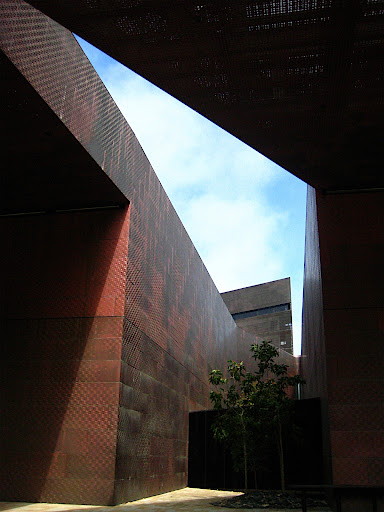
I too the day off work and went to the de Young museum today. It is a little embarassing that this is my first visit since its new facilities opened almost two years ago, the more so because I deeply admire the architecture. But such is the life of the incipiently agoraphobic downfall of a man who spends too much time working and not enought time pleasuring.
I had breakfast at some place in the Haight ... even at 10 a.m., the famous Pork Store Café had a line-up for their infamously greasy but still finger-lickin-good offerings. Still ploughing through that work on Albert the Great. Ended up at the museum around 11:30.
The architecture of the place absolutely dazzles, and I determined to focus the bulk of this first visit on experiencing the angles and textures and idiocyncracies of this edifice. I monkeyed around the vast lobby, and then headed upstairs to the American art galleries, and later to the Papuan art galleries.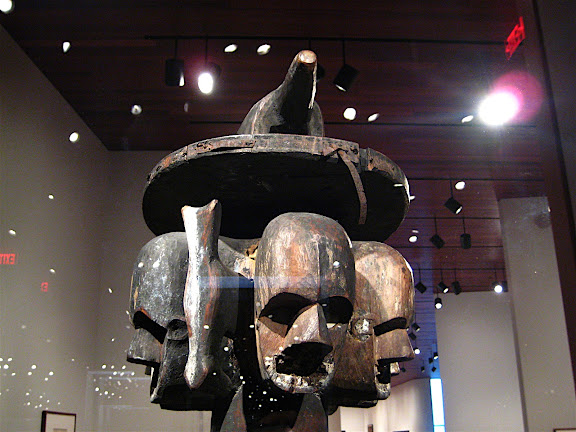
The stuff is pretty impressive, but the gallery makes you want to lie on your back and view the place as you push yourself along with your feet. I tried to take a gallery-wide photo, but it was too motion-blurred to permit of uploading.
I love museum stores, even if I am loathe to part with my money. I almost bought the catalog to the evocative retrospective on Peter Max's graphic work that represented the Summer of Love, but thought better of it. I was 15 that summer, and my consciousness was much more involved with the events in Paris and Prague than San Francisco. Poster art is cool, but you always feel like you should have it for free, so I let the volume lie, and thought only once about whether I should come back for tonight's advertising book signing by the now 70-year old artist.
I had a beer in the courtyard ... strange for me to drink with the sun up, but perhpas I am entering my happy dotage ... and had a lovely long read about Albert. And I was ready to leave when I glanced down a long staircase and caught a view of a mysterious black and white photograph.
And so I stumbled on the transfixing work of Hiroshi Sugimoto, a still active and iconic Japanese photographer who works in huge formats, typically black and white, and specializes in, using my own words, changing the vision conceits of his viewers. The series of a dozen or so seascapes, dedicated to the notion that we might try to see things as are ancient, per-historic ancestors might have viewed them, are still and silent and they take your breath away nont by reason of exhilaration but by reason of their ability to encapsulate in one moment millennia of time. His series of movie screens, in which he opened the shutter at the beginning of the movie and closed it at the end, have the same stillness in the face of motion, even if the time frame is considerably more restricted. Click on either photo to go to his site ... buy the book. I did, and I hope to write some more about it in the future.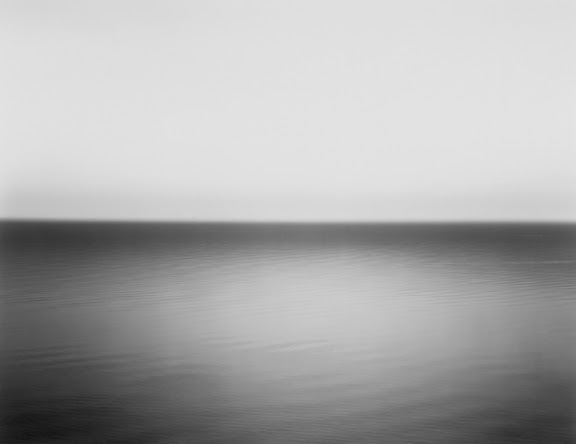
Museums are temples for me. I am never so calm or so complete as when I am padding around one. I believe in moving slowly, picking the pieces you examine and looking at them long ... up close and far away, front and back, right and left. Every museum I have ever been in is a representation of the oneness and the totality of the human experience. Any object which ends up in a museum has been liberated from the particularity of its creation. It is free now to belong to all of us, and each of us, one and the same.
Photos by Arod, except, of course, for the two Hiroshi Sugimoto images. Click on either of my photos for more photos of the de Young.
Saturday, August 18, 2007
Voice
Had a nice walk with Loki this morning, and a sweet concatentation of some of my favorite voices on the iPod shuffle. So here is a little stretch of music which accompanied us (well, Loki couldn't actually hear it, but let's say he picked up on the groove) through the Golden Gate Park stretch of the walk:
Alison Krauss: Oh Atlanta
Rosemary Clooney: Brazil
Incubus: Just a Phase
Old and in the Gray: Victim to the Tomb
Ray Charles: This Love of Mine
David Bowie: Song for Bob Dylan
Joni Mitchell: Barandgrill
Red Allen, Jim Buchanan, David Grisman, Herb Pederson: Love Please Come Home
Dixie Chicks: Baby Hold On
Joni Mitchell: You Turn Me On, I'm a Radio
Neil Young: After the Gold Rush
Nusrat Fateh Ali Khan: Be Wafa
My ability as a music critic is pretty limited ... the "I know what I like" sort of criticism. So pardon the obviousness of this: I like the foregrounded voice more than the arranged voice. So that Rosemary Clooney song is almost my national anthem, and the early Ray Charles does a lot more for me than the later. I love bluegrass voices, whether the rough and ready traditional stuff or the sweet clarion Alison Krauss.
No point to this post other than that ... some voices that I love to hear in the early morning, a cold wind blowing, the dahlias in bloom, the dog leading and following by turns.
Friday, May 25, 2007
Rufus baby

Frankly, I read the Salon piece on Rufus Wainwright only because his pic on the home page was so alluring. But his remark caught me:
I'm definitely a fan of juxtaposition ... using the most beautiful line to say the most horrific thing -- I think one of the main things in songwriting is definitely friction between the words and the melody. It's got to be done very delicately because both elements are somewhat explosive, and all of a sudden the song becomes like a crystal meth lab. You know, you don't want to blow up your family.
I'm only dropping this here as a placeholder because juxtaposition was a major idea in my dissertation. I used the phrase "juxtaposition and reversal." I am frankly not really up to writing about it right now as I lounge through a good start by the Giants young tuffie Matt Cain ... and that is a classic tuf baseball name ... but I will come back to juxtaposition some time soon. Meanwhile I get to mount that sexy photo.


