This is what the San Francisco Chronicle wrote about the American Conservatory Theater/Kneehigh Theatre production of Noël Coward's Brief Encounter: "Every so often a theater piece comes to town that is so brilliantly conceived and executed, so entertaining on every level, that you want everyone you love or even like just a bit to see it. Brief Encounter ... is that kind of experience."
Couldn't have said it better. It's on until October 17. There is a really cool site including a trailer that doesn't do the piece justice here.
The work is based on Coward's well-known 1939 play Still Life, and there is a better known movie, which of course I haven't seen, called Brief Encounter. The present production melds film, stage, railway, song, movement, and audience into a new, and yet old, retake.
It's about love. There are three love affairs: the central one in which two middle class folks come to the edge of losing their good sense, and two background love affairs among the railroad station cafe staff. The latter are bawdy and humorous; the former is dark and heavy, ultimately unrequited.
All that fun on the stage and I came to want some fulfillment. Coward, of course, would never end the thing in death ... perhaps someone can correct me if I am off-base here ... but there is a little death in the soul-destroying return to the sensible. All the fulfillment is in the bawdy joy of the other two relationships.
The essay in the program pointed out the poignancy of one of the songs ... Room with a View ... because of what it would have represented to the then marginally closeted Coward. He could not have true love because that was denied to homos. He could only have the bawdy slap and tickle stuff, and that only when he kept it quiet enough that it did not "scare the horses." So the contrast between the two bawdy relationships and the furtive and ultimately unfulfilled middle class liaison reverses itself ... the homosexual author lusts after a formal relationship without all the middle class nausea about the sensible.
Enough said. Very enjoyable.
Saturday, October 10, 2009
Brief Encounter


Sunday, May 31, 2009
The Ancients Whisper: Enlil and the Wind

I've been reading Samuel Noah Kramer's History Begins at Sumer, published in 1956. My edition was the first Doubleday Anchor paperback published in 1959, sold for $1.95, and one of those classic old paperbacks that the bibliophile loves to fondle. Alas, like so many old paperbacks, the spine did break despite my best efforts. None of the folios have slipped out, though.
Preserving an old book is what Kramer did, of course, though his books were in the form of tens of thousand of broken clay tablets. Kramer does not lack for pride in his work, but he did put together many previously separated chunks of fable and myth. I am not sure what his reputation is now in the field; the Wikipedia article is certainly laudatory.
What I know about Sumerian religion entirely derives from Kramer, and something like six readings over the course of my life of the Babylonian epic about the Sumerian Gilgamesh; I am going to tackle that again once I am done with Kramer. So what I write here is pretty impressionistic, meant more to illustrate where my mind is going in trying to imagine for myself the nature of consciousness in the earliest civilization about which we have written evidence.
Written evidence, of course, is what defines civilization if only because we know a great deal of what we know from written evidence. Cuneiform was a remarkably long-lived and relatively stable form of writing; it was in active use for a longer period of time than the time that separates us from Homer! And, of course, because its medium was clay, we have an enormous resource of fragments and remnants.
I am interested in the scribes; I am always interested in the classes to which I might have belonged had I been born into another era. The earliest writings about Sumerian civilization in Uruk (in modern southern Iraq), the biblical Erech, include descriptions of the intense curriculum and strict corporal punishment provided to prospective scribes. The graduates stood to inherit high position in society, at the cusp between the religious establishment and the political power. Most of what they wrote was bureaucratic, and this provides us with a deep look into economics and social relationships at the dawn of history. But there is enough writing on myth and attitude to give us great insight into the mind.
Kramer points out that the Sumerians did not write what we might call meta-prose ... speculative supervening prose that situates and explains. I would say that this reflects what I called the immediacy of myth and speculation when I discussed Herodotus. The Sumerians were very good at lists, as were their inheritors, and those lists have provided not just enumerations and chronology but also great sources for translation and deciphering. Lists and the immediacy or unmediated quality of reflection are characteristic of chirographic society ... that is a society in which writing is produced by experts for consumption by a society which remains radically oral.
So in the case of the myths which Kramer outlines, we see the repetitive style and textual chunks typical of oral texts, but we see them in written form. By chunks, I refer to stock phrases ready at hand for an oral storyteller; the most famous is the Homeric "wine-dark sea". The storyteller has these elements, preformed with rhythms and measure appropriate to the genre, at ready hand so as to make easier the task of putting a story together in performance. BTW, Kramer makes an error typical of his era (see page 137) when he says that the scribes are the "heirs and descendants of the illiterate minstrels of much earlier days" ... first of all, I prefer "non-literate" rather than "illiterate" because you can only be illiterate in a society which is radically literate, in other words in a society in which the vast majority of people read and write. This was not the case in Sumer, or indeed in any society until much later. But more importantly, we can have little doubt that the "minstrels" were contemporaries of the scribes, as evidenced by the oral techniques with which they wrote, but also by induction since storytellers have been characteristic of all radically oral societies. The "minstrels" and the scribes lived in the same lifeworld and they had exchanges and interchanges which we can only imagine since they apparently are rarely if ever depicted in the sources.
So the scribal arts, notwithstanding the literate caste that produced them, reflect the oral society in which the life world is immediate and unmediated. The gods are viewed as ever present, constantly going about their work, and living their lives, but invisible to humankind except in the effects that they produce. The four major gods are An (heaven), Enlil (the air god), Enki (god of the abyss and wisdom, and the organizer god), and Ninhursag (the mother goddess). But there are also hundreds of gods in charge of more or less everything and anything. It becomes a rather impersonal system, one fitting for a people unprotected against ill-fortune and bad fate, so they developed a system of the personal god who could serve as an intermediary to petition for or act on behalf of the individual with the other gods who, seemingly, were unconcerned with the fate of one person or another.
It is noteworthy that in a thought system where there is no evident conceptual mediation (i.e., where cause and event and consequence are seen as immediate and connected and inseparable), a mechanical form of mediation is invented in the ethereal realm to represent the possibility that cause and effect can be split apart. Compare that to our personal god ... Jesus ... who mediates between the very distant, unerring, and unchanging god the father, but in doing that, he himself is distant, unerring, and unchanged despite his dabble in history 2,000 years ago. There is something deeply revealing about this structure of divine portrayal, and the evident necessity to invite a mechanical means in the form of the personal god of breaching the divide between the immortals and us.
The unchangeability that we project to the immanent but distant god, the Sumerians found in their everyday life. It was a lifeworld that appeared as stable and immutable, and change was something that had to be entreated. Kramer writes, "The main thesis of our poet [of the first version of the Job myth] is that in cases of adversity and suffering, no matter how seemingly unjustified, the victim has but one valid and effective recourse, and that is to glorify his god continually, and keep wailing and lamenting before him until he turns a favorable ear to his prayers." That god is the personal god of the individual supplicant who, by this means, had some recourse against the immediacy of fate ... but a recourse of little effect and much wailing and bemoaning.
Again, this is pretty broad speculation based on a limited set of facts known by the writer, but it is how I try to imagine consciousness when people are in possession of a different set of not only notions but also explanations and facts.
I think this idea also explains why Enlil appears over time to have displaced An, the heaven god, as the primary god. Again, for us, the primary god is always in heaven, and heaven which is above us, unknowable and unimaginable, unreachable except through death and redemption. For the muslims, it is a layered above, albeit rather fully explained in their much more mechanical textual approach to religion, but admission is at the behest of the god who is without intermediary.
But for the Sumerians, the action was not in heaven. Enki, the god of wisdom and organization, ran the world. But Enlil was the wind, the air ... that is, Enlil was what mediated between heaven and earth, what caused change, what brought good and evil, what moved. Enki established the rules of culture and living, and ultimately ordered people as they died and went to the underworld. But Enlil, the wind, was the great god, most in need of sacrifice and appeasement. He was the divine representation of mediation, and thus appeasing him was of central importance in undoing the terible effects of change upon a world where immediacy was the coin of the realm.
Again, this is a mechanical way of representing mediation in a world in which mediation was not the default position.
I hope that this is not too obscure ... and I really hope that it is not utterly wrong. I'll try to return to this when I have re-read Gilgamesh.
Photos by Arod of the sky. Top photo taken at MRU, the major research university where I hold out my hands expecting a rain of heavenly delights; second photo is of the hill in the park behind my house in San Francisco. the third is the sky reflected in a window which, as I recollect, is on Haight Street in San Francisco.
Sunday, February 15, 2009
Stanley Goes to the Fish Market

I read Stanley Fish's blog in the New York Times pretty regularly, and he recently published a piece called The Last Professor. The post questions the survivability of the humanities in the academe, and refers to a recent book by one of Fish's students, Frank Donoghue, who has a new book entitled “The Last Professors: The Corporate University and the Fate of the Humanities.”
Fish argues for "higher education as an enterprise characterized by a determined inutility" ... I refer to a similar concept in the phrase "the tyranny of relevance." Fish writes (and I have conflated two paragraphs for clarity's sake):
This view of higher education as an enterprise characterized by a determined inutility has often been challenged, and the debates between its proponents and those who argue for a more engaged university experience are lively and apparently perennial. The question such debates avoid is whether the [ideal of Michael Oakeshott that "there is an important difference between learning which is concerned with the degree of understanding necessary to practice a skill, and learning which is expressly focused upon an enterprise of understanding and explaining"] (celebrated before him by Aristotle, Kant and Max Weber, among others) can really flourish in today’s educational landscape. It may be fun to argue its merits (as I have done), but that argument may be merely academic – in the pejorative sense of the word – if it has no support in the real world from which it rhetorically distances itself. In today’s climate, does it have a chance?
Both Fish and Donoghue say "no" ... regardless of the merits, scholarship as an end in itself untethered to an explicit and argued social utility cannot and will not survive.
There is plenty of evidence to back up their skepticism, not the least of which is that students increasingly look to post-secondary education with career in primary mind. The last flush of inutilitarian idealism might have been the 70s when people like me took classes in Chinese language whose principle was that the memorization of Tang dynasty poetry could lead to fluency. The result of that is that I can recite imperfectly two lines of a famous poem and I can scratch out around 25 characters.
 I believe, and I am in agreement with Fish here, that scholarship is justified about anything that is knowable or anything about which we still do not know everything. That covers pretty much any subject. To require an explicit tie between knowability and utility predisposes the scholar's work with reference not to the object studied but to a present paradigm that may have nothing to do with the object. This was precisely the tyranny-of-relevance error of the whole theory digression that bedeviled literary studies for a couple of decades ... I am happy to aver that the grip of airless theory seems to be loosening.
Having said that ... that study itself is sufficient argument for scholarship ... methinks Professor Fish got lost in the marketplace. Because as with everything, the pure argument, the single source of truth, is always wrong at least because it is incomplete but more so because it closes the door to the fuller explication of the underlying dialectic. You see, scholarship has never been free of the tyranny of relevance in any meaningful overarching sense. Certainly one has professor x who spent three decades deciphering runes while his colleagues snickered at his tawdry clothes and poor hygiene. But even professor x lived in an institution situated within a society, an institution subject to rulership, economics, pressures, and social changes.
Complexity is what interests me, and reductive-to-the-single-point arguments run out of steam. I can stamp my foot all I want about pure scholarship ... I could rage on about the undeniable fact that most professors produce precious little of memorable quality ... and I could feel good about it. But it would not get me closer to understanding the dynamics that are rendering scholarship in the current era.
I think you need to start with the counterposing pure scholarship and social context. They are never separate, though social context pays vastly less attention to pure scholarship than the other way around, certainly. The fascination is in the complexity of that relationship. I wrote a few days ago about a forum on the term "Islamism" and I hope that I prefigured a couple of these points there. Emmerson, the scholar talking about Islamism took the term out of its robust and fractious social context and laid it before us as something to be studied. I think that Emmerson lost a chance to change scholarship by insisting on writing a book about this term instead of creating a living monument on the web. But that demonstrates precisely the struggle between the pure scholarship of wresting the term from its context and looking it as a captured wave (not a fixed or reified object) and the social context that wants some feedback from the pointy-heads who do this kind of stuff.
Emmerson lives in a rarified world, the world of the endowed scholar who just thinks and writes. Great work if you can get it. I think that world has a responsibility to knowability, even when the objects it might choose to study are not relevant, or what is more significant posed-as-relevant, to come current issue or problem. In other words, we can demand of endowed scholars that they do something, and then we can tell them that we are free to make of what of what they do what we want. They can't own it or keep it back. Again, that is a dialectic.
The key to saving the humanities is to inhabit both terms of that dialectic.

At MRU, the major research university where I pile seashells on the beach in exchange for loaves and fishes, I have argued on numerous occasions ... and you must realize that I have no formal standing to make this argument ... that the humanities departments need to seize the idea of the double major. I like this one: French and Civil Engineering. Or, Classics and Urban Studies. Or, Art History and Mechanical Engineering. Or, History and Earth Systems.
Yes, there is a grave danger here that the humanities find themselves tied to a stated and required relevance. But, so long as one keeps this slippery slope in mind, such formally combined majors enable the humanities to inject into the real world the perspective of pure scholarship. More significantly from the social context point of view, they can round up some students and increase their own footprint.
So, the French and Civil Engineering works in Africa for the United Nations, the Classics and Urban Studies student intertwines classical ideas of open space and citizenship with modern transportation systems, the Art History and Mechanical Engineering student retains the notion of beauty as he proposes a bridge on a freeway, and the History and Earth Systems student comes to this most complex of human issues with an understanding that we have ripped our environments to shreds since we first walked the earth.
The humanities can surrender the social context parts of the double major to the science and engineering departments, and thereby liberate itself to its own genius, to whit the inutilitarian search for the knowable.
I propose this example by way of outlining a path for the humanities to engage with the world that threatens it even as it operates to save its most previous perquisite ... the ability of scholars to define for themselves what is worth studying. Moaning that the world has no room for us, well, that is an ancient complaint that has an odor not of striving and research but of coffee and upholstery.

A few further notes on complexity and military history
Last night at a dinner of five pointy-heads, my excellent friend Ian and I sparred about the Dresden bombing and that spun into Hiroshima and the Japanese surrender. Dresden is in the news these days because February 13 was the 64th anniversary, and the day often presages neo-Nazi marches about war crimes committed against Germany. There is a nice piece in the English Der Spiegel here in which Frederick Taylor, a British historian who has written extensively on Dresden, is interviewed. (I suspect he is the son of the noted left-wing British historian, AJP Taylor but I could not find any proof of that).
Taylor rejects the view that Dresden was chosen only because it was an architectural jewel and as part of a singular effort to destroy Germany by destroying civilian morale; he argues that these were certainly factors, but that it was also a significant military target. One can quibble, and we certainly now know that the carpet bombing strategy was not a significant factor in the defeat of Germany. But I find a reduction of the bombing of Dresden to war crime to be a kind of moral cubbyhole that exempts the viewer from the full range of dialectics at play in the moment. In other words, once we assign the single factor and require that all argument start there, we lose the ability to understand how things actually happen, how strategies in the high sense devolve into tactics on the ground, if I can make a macabre pun. But complexity of argument can readily come back to its starting point, and Taylor, the champion of a complex argument about Dresden does precisely that. The aforementioned interviews ends thus:
SPIEGEL ONLINE: Do you think it was justifiable?
Taylor: Personally, though I can trace the logic of it, I have serious doubts. It is a ghastly example of how war depletes the moral reserves even of democratic nations. Goetz Bergander, who survived the bombing of his native city as an 18-year-old and has written widely about its destruction, has described the bombing in his characteristically forgiving way as "outsize." It was certainly all of that.
I think a similar moral cubbyhole has long obscured clarity in argument, especially among liberals, about the events that ended the Pacific War in 1945. It has been argued that the Japanese were ready to surrender, but either we needed to give them time or we needed to figure some way not to force unconditional surrender. There is no evidence that I know that supports this other than assertion. Significantly ... and this is a grave error in anyone seeking to understand military history ... no credit in this view is given to the implications of the fog of war. What the Americans knew was that resistance had not stopped and that large numbers of troops were being amassed in the South in preparation to resist the assumed invasion. That the Russians had entered the war likely had more impact on the Americans than the Japanese military leadership much of which was committed to a fight to the death of the last Japanese; why would they care whether that final plucked life was given up to a Russian or an American?
But once we credit a notion that the Japanese were ready to surrender before Hiroshima, or that they really surrendered after Hiroshima because they were afraid of the Russians and not the bomb, we avoid a grindingly difficult moral argument: did the A-bombs result in a net of fewer deaths; and, if so, were they thereby justifiable?
That is the moral crux of the end of Japanese war, and it should not be avoided.

A last note:
I have meant to write about this for a few days, so I append it here. There was a touching article in the New York Times entitled "My Sister's Keeper". It concerns aging colonies of lesbian separatists who have kept the faith, as it were, with that peculiar 70s ideology. I want to note that the lesbian separatists did damage to the gay movement, and they are not heroes of mine even if they have lived their lives courageously as they saw fit and so desired. The gay movement of the 70s was overwhelmingly male not because we rejected women but because women rejected us. They had lots of excuses ... all men are rapists, the gay boys have too much sex, we expected the women to make the coffee while we did the movement ... but only one argument is real. Feminism of the 70s was homophobic in a dominant sense, that is in its majority and in its actions. Lesbians active in the women's movement felt they had to hide or at least downplay their homosexuality. The separatists, while hardly hiding from feminism, hid from the world and proclaimed that isolation as liberation. They contributed nothing to our present freedom, and their absence weakened us both in the short term and in the long term. I wish them well in their retirement, but the record tells the tale.
Photos by Arod. The owl is from a window on Divisadero Street; the lion is from a Board of Education building on Van Ness; the window reflection shot is just off Market near Gough; the statue is from Golden Gate Park; the finger is from Hayes Street (I think) near Masonic; all are from San Francisco.
Thursday, February 05, 2009
Islamism: What's in a Word?

I went to a lecture and exchange today featuring the Southeast Asianist scholar Donald Emmerson. He is writing a book with a colleague that amounts to a debate concerning the use of the word "Islamism" and the validity or lack thereof of self-censorship when confronting such a charged term. This colloquium was a presentation of his thought process with reference to his colleague's counter process. It raised some issues that are dear to my heart.
So, pursuant to a challenge issued at the event by the scholar Olivier Roy, I will start by providing a definition. Islamism, in my view, is the ideological use of Islam to influence state and society to adopt Islamic policies and practices. The term may be new, but the practice is old. I find it risible to suggest that Islam is just a religion, and political action should not reflect upon it. Islamists, like fundamentalists of all stripes, draw on their religious heritage to justify their campaigns, whatever they may be. All religious textual traditions contain irresolvable antinomies precisely so that they can be used variously to argue for peace and war, love and hate, acceptance and rejection. So no matter how violent or moderate the Islamist, they are from the religion and they argue their own legitimacy from the religion.
Enough of me.
Emmerson proposed a little diagram to explain his argument about the validity or lack thereof in self-censorship in addressing a term like "Islam ... I am not going to reproduce the graphic because I am not sure if it is proprietary or if he wants it bandied about. But he counterposes accuracy and considerateness, so that something that is accurate and considerate is contextualization; something that is considerate but inaccurate is denial; something that is accurate but inconsiderate is candor; and something that is inaccurate and inconsiderate is stigmatization. Nice, and I htink you can see where this is going.
I thought Emmerson produced a lengthy and erudite rationale for sometimes using the word so long as it well-grounded. His colleague ... I cannot for the life of me remember the name ... refuses to use the term ever. And the aforementioned Olivier Roy thinks it is a perfectly fine term ... he claims to have invented the phrase moderate Islamist in 1984 ... and uses it whenever he bloody well pleases, just so long as it is well-defined.
The subsequent comments and Emmerson's responses represented an erudite debate about language, usage, the role of scholarship in the world, and methodology. A knee-jerk response might be to find it all pointy-headed and airless, but that was just not what was actually happening. Emmerson pointed out that scholars actually have an increased role in public debate these days; I hasten to point that the notion that involvement in public debate justifies a given scholarship is a kind of tyranny of relevance. But it happens to be true in this case. There are many scholar talking heads on the news shows and especially on PBS. They too get rounded up into the sound-bite hell of modern broadcast TV, but they do have the opportunity to introduce terms and perspectives that would have been lost in earlier eras.
So the first issue is this ... since language matters and since language is fluid ... sometimes like water, sometimes like glass, mostly like something in between ... public rumination on the particulars of language has a high function. This is hardly confined to the present. I am presently reading Peter Brown's excellent The Rise of Western Christendom and he relates how the seizure of Latin by the church during Carolingian times liberated the vernaculars to develop much more freely ... and all of that arose as part of the debate about precise terminology and usage. In the case of "Islamism", the media use the term increasingly as equivalent to terrorist, and this certainly serves purposes. But simply to surrender a term, especially in these days of aggressive and ephemeral appropriation, is to surrender a discourse. No matter that one might lose eventually in a debate, one always needs to make one's points. So at the least, that function was served today.
At one point Emmerson argued that he had tried to change his usage of Islamism from representing a political Islam to representing a public Islam. I thought this was a dangerous slide because public does not need to represent an attempt to enforce a politico-religious ideology. But another participant had a sharper notion as a counterpoise to Emmerson's idea that public was broader (and, by my way of seeing his point, more forgiving) than political. This young man with an Arabic accent said that in repressive societies you can include secret activity in the political and that might be broader than the restricted realm of the public. So the public protestation of devout Islam in a repressive circumstance might be seen by authority as a challenge, and hence Islamist, but it is more readily tolerated and subsumed that secret political activity which is decidedly thereby Islamist. Because, as always with religion, it comes back to the state. There is no Islamism without looking at the state.
But more interesting to me than this ramble is this curiosity. Why did Emmerson choose to write a book that amounted to a dialogue, and to include in this book the responses of 12 selected contributors? Why not mount this on some kind of web site, and make it a dynamic experiment in public scholarship? The reason is two-fold ... first of all, the academe at its highest levels has been incapable of finding a route into the new modes of publication, and no one has risen to take the bull by its horns, as it were, to force the issue. So, secondly, Emmerson seeks to freeze something in time, to make a monument. But the time for monuments is passed, and the Emmersons of the world lose the immediacy of their arguments by fixing them in a book. This sort of argument is Internet-worthy, but not book-worthy because by the time it appears its urgency will have passed.
In my work, there are no excuses. The new technologies press in on us every day, and the urgency is constantly present. It's time for that to be true of the scholars who inhabit the sandstone building a stone's throw from the modular unit where I toil for wages.
This post developed vastly differently from what I imagined as I walked to the train tonight ... but here it is nonetheless.
Photos by Arod . Gawd noze why I chose these, though gawd noze everthang so it must be rite.
Sunday, November 02, 2008
The Quality of Life

A little context ... I took Thursday and Friday off to clean house in preparation for our little cocktail party in honor of Halloween. The house is as clean as it ever was ... which given the tschotschke density is quite a feat ... and the dozen folks who enjoyed our "fine ales and fancy shooters" were a fine crew. One of their number, my regular reader KW, challenged my notion that canceling Halloween in the Castro was homophobic; our exchange was interrupted by the revelry, but I promise her, and you, a sober explanation of what I mean by that assertion in the near future. And so, it is the Sunday evening of a four-day weekend, with great challenges awaiting me tomorrow. I made myself an early martini ... why? Because into every reverie comes something like ACT's production of Jane Anderson's The Quality of Life.
I quote the Chronicle review to set this up:
Set in the Berkeley hills after a major fire, "Quality" introduces Jeannette, an earthy, high-spirited woman played by Laurie Metcalf. Jeannette's husband, Neil (Dennis Boutsikaris), is dying of cancer. When her cousin Dinah from Ohio (JoBeth Williams) comes for a visit with her husband, Bill (Steven Culp), the two couples - one solidly on the left, the other resolute in their conservative Christian beliefs - are made to confront their huge dissimilarities.
It seems like the play shouldn't work notwithstanding the sterling performances especially by the two women, Laurie Metcalfe (the one person who was actually acting instead of mooning in TV's Roseanne), and JoBeth Williams of Poltergeist fame ... I wouldn't know about that given my fear of scary films. It seems like the play should be a boring recitation of the much ballyhooed "culture war" that fuels the righteous indignation of the right. And there were moments like that. But in the middle of this clash between a dying hippie alongside his life partner living in a yurt after a fire ruined them and a Midwestern couple whose daughter had been brutally murdered, in the middle of a fight over whether suicide is ever right, a little humanity bursts through.
Of course, as someone who lived through the AIDS deaths of the 80s and 90s ... as someone who ushered six best friends to untimely graves, and discussed suicide and the quality of life in pitiless and endless detail with every one of them ... well, it hit home. Yes, it hit home.
Spoiler alert ... don't read this paragraph is you plan to see the play ... the hippie wife, played superbly by Laurie Metcalf, announces that she has decided to accompany her life partner in this last journey. That's where the play turns ... and my theater companion Roy later remarked that he wondered how one would direct a play when the denouement closes the first act! And it turns out that the diehard Christian male is right about life, and the drinks-too-much hippie philosopher is wrong. They all end up estranged, but each side seems to learn something in the exchange. Notwithstanding the revelation of stasis that is the ending of this piece, it leaves its audiences in pieces ... it left me wondering about the meaning of life.
When my friend Jack died, his smugly affluent exurban family descended upon us as if from nowhere, and performed admirably. The parents asked me to chaperon the lover who was, how to put it, a wild-card, prone to embarrassing dramatics. We agreed on that. After Jack died, they executed his last will and testament to the last dotted i and crossed t. They did as he asked, and as his brother and I embraced for what would obviously be the last time, he said, "Not bad for a born again Christian." I agreed and hugged him one last time.
Not so with the exurban hardware store owners who parented my friend Tom. They undid everything he asked for as soon as his dementia was too far gone, and to this day, according to an old friend of his, they have not announced his death to any family friends in Michigan. They too are Christians.
But the death that most returns to me in thinking about this play is the death of my mentor and great friend Kurt. He is pictured above in one of his many alter egos. He viewed death as a friend; he said that AIDS had transformed him and made him a better person. We talked, endlessly and with brutal frankness about death ... for three years. But when it came, it took him by surprise, and despite all the preparation, he had missed a key problem. When it came, he could not swallow, and so the paper bag in the refrigerator was useless. He suffered unspeakable agonies for five days ... we never thought he would not be able to swallow.
I was with Kurt in his final delirium ... he imagined that there were giraffes in the room and he wanted assurance that the police were not involved. The staff of the VA where he died were sweet and helpful. But he did not die on the terms he had set for himself. And that is an unspeakable tragedy.
So to the play ... in the end, I had no sympathy for the Laurie Metcalfe character. I won't say what happened in case you see the play, but what happened is irrelevant in a larger sense. Those of use who survive ... those of us who watch early demise and thereby earn the duty to "bear witness" to it ... have a duty to live. Grieving is inevitable, irreducible, a duty and a torment. But surviving charges you with the responsibility to sequester the grief and move on so as to do what the lost cannot do but would do.
The AIDS deaths ripped me apart, and introduced a sorrow into me that never quite fully leaves or dissolves away. But I do not approve of even the soupçon of self-pity that I allow myself. This part of me actually disgusts me a little. I wish I could mount a great charger and impress my friends who are now only dust. There is no reason why I shouldn't
So I thank Jane Anderson for making think about death again. And, more to the point, life.
Wow ... this thing did not go where I intended it to ... but there it is.
Monday, June 09, 2008
Picking Winners

Giants win! Swept the hopeless Nats in Washington. Baseball is a zero-sum game (see principle number 1 in the header to this blog) ... I get one, you lose 1. No other way around it. Wins count, losses don't.
Now, of course, there is a lot more to baseball than wins and losses, and the joy of the game is precisely in that non-zero-sum game aspect. But at the end of the day, as the wee Scott McClellan likes to say, it's all about winning. And losing doesn't count.
I assert, contrarily, that in human affairs there is no such thing as a zero-sum game. Sometimes a difficult idea to defend. Look at the Obama-McCain race ... one wins, the other loses, and if McCain wins, we are in big trouble. But even in something as cut and dried as an election, there are so many factors at play that reducing it to one result loses the observer all perspective.
In my personal reading, I am now at the end of Christopher Clark's Iron Kingdom: The Rise and Downfall of Prussia, 1600-1947), and as we all know, Prussia comes to a terrible end. It is hard not to look at Prussia in 1945 as the losing end of a horrible zero-sum game. Indeed, historiography has long held a singularly black/white view of Prussia.
Clark's strength as a historian is that he resists the black/white, off/on, winner/loser view. In that, he curiously represents another social contradiction often falsely seen, even here, as a zero-sum game. And that contradiction would be the rise of the theory-mongers in the academe and the terrible damage that they have done to thought and research. At least, that is the narrative preferred by many, again myself included in most contexts.
But it is a narrative that fails the moment it becomes universal. Take this as a proof. In looking to fill in a few of the date-type details about which a "social historian" such as Clark is sometimes lax, I managed to pick up 2 of the 3 volumes of a well-regarded and authoritative 60s history of Germany, Hajo Holborn's A History of Modern Germany; the Wikipedia page points out that the incomparable modern historian and biographer of ideas and thinkers, Peter Gay, was his student. This connection is a little ironic in the context which I will argue.
Holborn's book is hard core history for date lovers. It is clipped and chopped, neatly separated by subheads. It is authoritative and reliable, and this sort of reference work is valuable on the shelf of any history-buff. But one does not feel compelled to read the thing from cover to cover because ... and this in itself is an artifact in the changes in intellect over the last several decades ... the constitutive unity of enduring contradiction seems absent from the work. Holborn wants to pick winners and losers.
More to my taste is Clark who lives perpetually in the unresolved contradiction. One does want, from time to time in these social histories, a chapter that delineates the events in order. But this lack is more than amply repaid by the subtlety with which an author like Clark ... or Tim Blanning about whom I have written before ... brings the contours of an era to life. It is not just his persistent focus on the state and the contradictions that underlay it and from which it could never separate itself; it is also the way in which he describes the interplay among forces forged in that contradiction, and yet seemingly immune to the sorts of developments, obvious in hindsight, that might have saved their supporters.
I am going to try to return to the Prussian state in the next few days. What I want to address today is that the theory game that ravaged the humanities over the last three decades is itself also not a zero-sum game. It has, as I argue here, been the proximate cause of the rise of what I am broadly calling social history, and this has been very productive of new understandings. It might drive those who prefer winners and losers to drink because this is history that sees good in evil, and that sees redemption in defeat. But it is history that demands deeper reflection on what it is to be human.
In the literary zone, the "depredations of theory" are a little more difficult to champion, the more so because they had the tendency to draw attention away from the text. That is an unfair statement, as any graduate student will aver, because the new literary movement was precisely the force that opened up the notion of the text, such that genre conventionally defined could burst its boundaries. Literary theory has troubled genre and text, and notwithstanding the pointless obfuscations of the Julia Kristva's of the world, it raised challenges to parsed out traditional criticism that have enriched our ideas of what constitutes work and influence and meaning. As with Holborn, this is not to toss old critics into the trash bin, but rather to note that intellectual dialectic can never stop, even when it backs itself into a corner.
More than anything, my graduate student battles with the theory ninnies made me a part of an eternal evolution ... a punctuated evolution ... in which ideas about ideas, or tellings about tellings, always fall back into themselves the better to reconstitute themselves on the next level whatever that may turn out to be. My best graduate student friend, JS, who has drifted out of my life, called me a conservative formalist at one point. I took that as a high honor, but I think it is wrong now. I think I am a half-breed chameleon ... I want to be present and involved even as I grouse about it all. But you can't be present if nothing is happening, and whatever is happening is that at which you must choose to be present.
A little circular, I guess.
From such struggles we get the revolutionary work of my adviser at Cal, Amin Sweeney especially in his A Full Hearing: Orality and Literacy in the Malay World ... about which I really must write something at some point ... and the pleasurable works of Clark and Blanning.
So much intellectual discourse is between the Weltanschauung ... one of my favorite words when I was 19 ... of those who want to pick winners and losers and those who want to live in unresolved contradiction. I am of the latter type, notwithstanding that I always pick the beloved Giants to win any given game.
Photo by Arod of a window on Castro Street.
Saturday, May 03, 2008
Curse of the Starving Class
 Nice day. Breakfast with friends. Car in the shop for a thousand dollar clutch and fly wheel job ... a thousand dollars for something I will never see. Went to the American Conservatory Theater's production of Sam Shepard's Curse of the Starving Class. And as I write this, the Giants are leading the Phillies in Philly 3-2 in the bottom of the 10th, Brian Wilson pitching, one on, one out. I'll keep you posted.
Now as to the play, first off, ACT again did itself proud with a spectacular set that evoked grinding rural poverty and desperation. They always amaze. I wish that they were a lot less stingy with images of their work on their web site ... it is general complaint with the web ... we are all aching to consume images, so let us see. Don't be stingy ... let us look.
As to the play ... I told RO, who is my theater muse and with whom I attend every ACT production, that it was like we started with a David Mamet and ended with a Harold Pinter. The play concerns a poor farmer family with a violent drunken father (Weston, Jack Willis), an aloof mother (Ella, Pamela Reed), an angry and confused son (Wesley, Judd Williford), and a wild 12-year old daughter (Emma, Nicole Lowrance). The first act is a lot of setup .... you certainly know, not merely because it is a Shepard play, that these folks are losers. But in the second act, it all gets kooky. Characters start switching roles ... the drunken dad dries out, and the son turns into Dad. So does the Mom.
Shepard does not have the facility with genuine dialog that Mamet has or Tom Stoppard. There are a lot of truly peculiar lines, including using the word "authenticity" at one point. So there is a bit of the theater of the absurd in the thing all along. You know these poor sods are about to be swindled out of their parched patrimony. If this were just tragedy, then, the deed would be done at long last and they would stand there bereft and abandoned of hope.
But even by the end of the play, the deed is not done. The father has fled, the daughter leaving as well, pre-teenaged to pursue a life of crime. I thought she was blown up in the off-stage car explosion that was near coincident with her exit. No mention was made. The explosion and the two toughs who entered to prance and threaten ... well it seemed too much.
But there is a method, one must assume, in this madness. Part of it is to underwrite the dark comedy that courses through this work. It is also that reflexive comedy of writing for the cognoscenti who want to think themselves versed in the ways of the ignorant and unwashed, presumably with a certain pride in the breadth of their wisdom ... or who want to experience again the vicarious emotions of having descended from the descents of society. In other words, using my own example, I am two generations away from a blacksmith, so Manhattan-fueled though I may be, I know my proletarian bitterness, "goldernit". In that sense, I figure that a couple of Okies spitting "authenticity" back and forth is Sam Shepard's little spit in the eye of the audience which he presumably loathes.
To be a playwright of bitterness is to spit in the eye of your audience, knowing that your audience gets the joke and doesn't think itself all wet thereby.
The Saturday matinée crowd is, shall we say, a tad more senior than the average crowd, notwithstanding that live theater these days is generally the province of audiences getting more elderly all the time. When the studly Wesley faced the audience to take a long labored piss on the shrill Emma's 4H project which shows how to cut up a chicken, one of those tall, built, upper class ladies who favor unfashionable and bulky heavy tweed knits decided she had had enough, and she up and left her seat in the front row. We habitually inhabit the back row orchestra by the door, and so were able to hear her mutter loudly to the usher as she passed, "I am too old for a display like that." Another large lady of upper class demeanor chose another tense moment to disturb a long row of people so she could walk out. Sam Shepard is not every bourgeoise's coupe de thé.
The other moment that might have occasioned faint-headed yet headstrong dudgeon was when Wesley appeared completely nude, picked up the live lamb in the crate, and exited stage right. He displayed, among other assets, an unusually round and muscular tush, if a fevered fag may be allowed to pass his professional judgment.
Such titillations aside, it was a creditable performance of a difficult work where pain and bad fate lurk in every moment. Shepard is a round caricature of himself, and he gets the joke. So the themes he treats strike home even when his realism is off the mark. Indeed, being off the mark becomes part of the mark. I think the actors got it, and that is why they succeeded.
Then again, I am usually wont to enjoy live theater. Perhaps my dear friend LP will finally start her theater blog and pass judgment with a little more sharpness and theatrical insight ... wink, wink.
And the requisite reviews ... Jack Willis was perfect, as he usually is, especially in roles demanding a characteristic American accent. Pamela Reed was creditable, but I think she tried to give her character more character than it deserved. This is a desperate empty women, stuck in her lot, and ready to screw anybody to get out of it. Judd Williford did well given the difficulty of the mix of confusion, innocence, anger, and bitterness demanded. He did innocent best; when he pissed on his sister oevre, it was hard to imagine the motivation. Nicole Lawrence was the least believable ... she just didn't seem 12, even considering the precociousness that a life of desperation visits upon the young. She was best when she was screaming and wailing. The other parts were all fine, although the bar owner was a little over the top.
Still, see it. Makes you think which is what it is all about.
Here's another take on this production.
Let me note, Manhattan (Evan Williams bourbon, Punt e Mes vermouth, and Fees Brothers bitters) in hand, that the Giants won on a great play at short by Burriss ... and as for the thousand dollar clutch job, well, it might seem harsh. But it's an 86 Honda Civic, and a thousand a year, which is what repairs normally amount to, turns out to be a lot better than four or five hundred a month for something new. And at 34 mpg highway, and not very much driving, I feel I am okay if not completely pure. And, notwithstanding my forefathers, neither the thousand nor the beat up auto makes me a member of the starving class ... or so I hope.
Photo of Sam Shepard from his site.
Wednesday, April 16, 2008
Somewhere Over the Rainbow
Thinking a lot these days about the relationship between the Enlightenment and religion, and between the Enlightenment and romanticism, and between what Tim Blanning, in his fabulous book The Pursuit of Glory: Europe 1648-1815, calls the interplay between the culture of reason and the culture of feeling. These issues are at the heart of human history over the last two centuries, and they still define much of where we are at. So I'll try to get back to a more intellectual approach to those questions shortly ... at least before I finish the Blanning book and dive into a re-read of my favorite absolute monarch, Frederick the Great.
Said Diderot: "Everything must be examined, everything must be shaken up, without exception and without circumspection." Notwithstanding the obviousness of this and its unrelenting rationalism, it is a cruel prescription. It is also the prescription of an ideologue, for it presupposes the extinction of its opposite. History does not work that way, and in the event, notwithstanding the enormous gift that the Enlightenment gave to humanity, it did not work that way for our heroes, that is Diderot and his pals. Blanning calls the Enlightenment the culture of reason. And then there was the revanche of the culture of feeling.
Goethe said in his "Concerning German Architecture": "The only true art is characteristic art. If its influence arises from deep, harmonious, independent feeling, from feeling peculiar to itself, oblivious, yes, ignorant, of anything foreign, then it is whole and living, whether it be born from crude savagery or cultured sentiment."
Look at the difference between the key terms of those two statements: examined versus feeling. Look at the difference between the positive statement of Diderot against the essentially negative statement of Goethe. For Goethe, that which lives is that which is not foreign, that which is native, natural, peculiar, and, yes, ignorant.
In our era of the economic triumph of the rational (not to say that economics is rational, by the way), we have become witless victims of feeling. The truth is in the middle, of course, and perhaps I can demonstrate this by the following.
So there I was in Winchester, relaxing in the newly remodeled and fabulous living room of my brother and sister-in-law. It turns out that they are fanatics of American Idol also, and we had resolved to spend the Tuesday evening of my pilgrimage to the Cheese Capital of the Ottawa Valley passing opinion on the efforts of the remaining eight contestants. The boys again outsang the girls, although that did not prevent the fickle public ... and remember the claim that the "public" was invented in the period roughly comprising the Enlightenment and its lead-up ... from voting off the smoothly talented Michael Johns.
But what hit me, again, was the Jason Castro version of Somewhere Over the Rainbow. Have a listen (I have substituted a later studio version because YouTube killed the earlier version I had here):
My sister-in-law did not know that this song is an anthem for gay men ... I wonder how many gay men younger than I am know what this song meant to gay men before gay liberation. It is, of course, Judy Garland's song, and Judy died on June 22, 1969. When the cops raided the Stonewall bar in the early morning of June 28, 1969, the nelly queens were still mourning their fallen heroine, and their grief and rage and pent-up yearning to be free created the riot that launched the movement to which I owe my freedom. She is our Joan of Arc, and her terrible death spurred us to seek our freedom.
Now listen to Judy sing it:
"Why oh why can't I?" You see, the essence of the appeal of Judy's version is that it is an appeal to reason. Beset by her troubles, most particularly the horrid Miss Gulch who wanted to take away "that little dog", she wonders why things are so irrational, why she can't fly as birds do. There is no rational reason why she cannot live rationally. The essence of the movements for freedom of the 70s, the gay movement, the black movement, and the women's movement, had that precise negative appeal to reason: there is no rationale that adds up to denying us our ability to be fully human, to do with our lives as we wish to do.
No doubt Judy's song is filled with feeling. It moved me when I was a child, and it still sends chills down my spine as I listen to it on YouTube. But, no matter, it is still an appeal to reason. And thereby, we can see concretely how reason and feeling are not inimical.
Where, then, is the reason in Jason Castro, hot and appealing, his neck bedecked with a cross?
Simon Cowell mentioned a version on the Internet by one Israel which, like Castro's version, features a ukulele. Again, have a listen ... this one is a little longer, so feel free to cut out:
Israel Kamakawiwo'ole died at the age of 38 in 1997 of respiratory failure due to obesity that, at one point, topped 750 pounds. He is held in high regard by Hawaiian musicians. But his version is a song stripped of any appeal to reason, and left with only feeling. It is pure sentimentality ... the fact that a song that Judy Garland made iconic in about two minutes rambles on for over four minutes ... well, the maudlin always takes more time than the iconic.
I like this version. It filled me. But there is nothing here but feeling.
Poor Jason Castro, a sweet boy with alluring tight pants, just has no clue about any of this ... certainly nothing in his performance alluded to the historic resonances of this song. If Israel's version was pure feeling, Castro's version stripped away the feeling and left us with affect alone ... skillful affect, certainly. I admit that I enjoyed the performance. I hope the boy hangs in there and makes a record. But that spare individual style of his has no depth ... he would be ideal for Christian music ... it has no savoir faire, it has no reason. It has no approach to the realities that grip us and control us and toss us to and fro. He is not a new Bob Dylan, he is the person whom Tiny Tim lampooned.
So when we think of of the enduring dialectic between the culture of reason and the culture of feeling, we have to remember that reason has feeling and that feeling is never bereft of reason. It is not good enough to draw up the dialectic ... we have to define the terms. Feeling stripped of reason is a zero divider, as I like to say ... any equation in which here is a zero divider can admit of any answer. When people say that they just feel that there must be some higher purpose, they open themselves to anything ... and history has shown us that "anything" can be bloody awful.
But on the other side, reason without feeling is the motor of the ideologue ... the potential for a relentless "truth" that extinguishes the very reason that bred it.
In either case, without the dialectic, we are left with Miss Gulch.
Wednesday, March 19, 2008
The Impostor
 The tale of Lev Nussimbaum aka Essad Bey aka Kurban Said, and its competent telling in Tom Reiss' The Orientalist: Solving the Mystery of a Strange and Dangerous Life, throws into stark relief both the attraction of the impostor and the irreducibility of historical context in human lives. Born into a wealthy oil-magnate Jewish family in Baku (now Azerbaijan) on the shores of the Caspian Sea, Lev responded to the brutal reverses of the 1905 and 1917 revolutions, and then the rise of Nazism in the country to which he as exiled, by writing and re-inventing himself. Reiss writes:
For most of his life until fortune threw him to a place where he could no longer joke about such things, Lev would keep up a kind of comic dialogue with his writer friends about his "transformation" from Lev to Essad. It was not that he mocked his conversion or allowed others to. But among those he felt he could understand, and these were mostly his fellow Jews, he seemed to think it fair to reveal the transformation. With anyone else, he grew circumspect, neither denying nor accepting that he was covering up something. Rather than trying to refute anything, he responded by diving deeper into his identity and becoming more and more the Orientalist--more and more Essad Bey.
Remember transformation for a moment. I'll come back to that.
Many Jews of the late-19th and early 20th centuries adopted a stance as eastern, Asian, non-European, seeing in Muslim and other Eastern peoples kindred spirits opposed to the Europeans among whom they lived and who reviled them as conjunctures demanded. Lev was of this ideational caste, if you will, and as such might not precisely be seen as an impostor if we can accept that he genuinely converted to Islam and subsequently adopted a Turkish name. But he rewrote his past, and he dodged his present, and his religious system was always an act and never a belief. The identity came first and religion had to follow. That is a less rare pattern than one might imagine ... I believe it is precisely the pattern that has so many atheist politicians trundling off to church every week (does anyone with a rational mind believe that Hillary truly believes, or for that matter Obama notwithstanding his genuine earnestness?).
There was one exception to the precedence of artifice over belief in Lev, however. He was a genuine monarchist, a devoted follower of the dead Czar as well as the exiled Sultan and erstwhile Caliph. The historical background is that his life declined along with monarchy. But there is more to monarchism than nostalgia. It represents a pointed and deliberate false consciousness especially in a man as quick-witted and intelligent as Lev.
Monarchism is the worship of impostors. How's that? Monarchy is like religion in that any rational analysis reduces it to the nothing that belies it. What props up monarchs and gods is charisma and history and, again, irreducibility. To abuse the phrase of the day, they are what they are. So long as they hold power, they are powerful. When they no longer hold power they are windbags ... nothing more than the puffed up claims that surround them. To believe in them after their demise is affect because there is nothing to believe in ... the charisma has become a chimera.
For a man who constructed his life from whole cloth, monarchy conveys a sufficient reference to a reality in which the impostor can invest so as to create an imagined reality that is the imposter's stock in trade. Look back, young man, for the future bodes ill. It is in your imagined past, young man, that you can find the girding that will save you, nourish you, make you into what you can no longer be.
Again, Reiss writes:
He had had few friends growing up and had a precocious child's wariness of other children. Indeed, his passage praising absolute czardom begins with a short speech on why "I love old people, detest the youth"; the old are "calmer, cleverer, and more modest," and when the young turn their backs on them, as they inevitably do, they "must consequently fall into barbarism."
I love old people too ... like my father before me, I have always had friends older and often much older than me. As I get older, I tend to grouse all the more at the barbarism of intemperate youth ... notwithstanding the obvious fact that they are pretty wallpaper. That said, I have always been young ... by which I mean that I am impatient and revolutionary by nature. I do not brook idiocy and my definition of idiocy is broad and sharp ... I also enjoy oxymorons ... and I fail to understand why people are stuck and incapable of understanding history and necessity. The older people who are or have been my friends are young in that same way. And by turns, so many of the young about me are old in the sense that they accept what is given to them and look only for their own comfort. They bear similarity to the young of Lev's day I that they accepted what was given to them and looked for their own aggrandizement through a reductionist view of history. Our youth seem to have no sense of history ... time will have to tell whether that is a benefit or a torment.
What Lev saw in the old was that they understood transformation in a loose way, a clever way, modestly and with a smirk and a smile. What he detested in the young was their ideological fervor as he experienced it in the rise of the goose stepping youth of the brownshirts and the imperturbable murderers under red banners.
So, transformation. Impostors do transformations. They are loose about it. The con man smiles and draws you in. My father called one of my younger brother's best friends a "beloved infidel" ... the guy was an impostor, but you had to believe and you had to accept the letdown because you knew you had believed. You could not pretend otherwise. Transformation on some level is not being able to pretend otherwise.
There is another kind of impostor, the one who does fake-outs, and regressions, and bait and switch. The one who substitutes glibness and the snide for the con man smiles. What is appealing in the impostor like Lev is disgusting in the ideological impostor.
I speak, of course, of neo-cons and other such reductionist ideologues of contempt and self-assurance.
My readerly ride through the terrifying years of the 20s and 30s with Lev/Essad was a little easier than it usually is. I have always found the interwar period one of the most difficult in history to imagine because the horrors into which it descended were so unprecedented in scale. Did Lev's peers know? Did the cabaret people, the communists, the brown shirts, the working class, the street walkers ... did they have any inkling of the guillotine blade under which they lived, of the rapid drop into hell which the uncertainty of their lives portended?
In that vein, I sought out some reading on the development of thought and politics in the 19th century. I really want to read about German and Italian unification, but then I stumbled on Michael Burleigh's Earthly Powers. Sure, I thought, there's a meditation on how junctures arise in history.
Alas, the book is mired in the inability of the simple-minded to get beyond finding someone to blame. And who, do you suppose, would be at fault for both Nazism and Bolshevism ... why the Enlightenment, of course, not to mention pretty much anybody who lived before during or after the events and to whom one can paste the label "liberal".
The book was so nauseating that I could not get past page 44 ... I actually wrote "this is unreadable" at the bottom of page 39. The problem too often with the modern ideologue is that he cannot let himself resist snideness no matter how many opportunities are presented. Adjectives and asides and little sneers everywhere. So, speaking of the era of the Enlightenment, he writes:
Censorship, lax in practice but all the more resented in theory, as well as ferocious blasphemy and sacrilege laws, sought to compel orthodoxy. The philosophes tended to highlight the most extreme cases, often omitting crucial details that might have modified their starkly contrived contrasts. (page 30)
Elsewhere, he refers to the "several existing tendencies and novel developments that are known as the Enlightenment" (page 37) ... in other words, the great force that initiated the permanent decentralization of religion and idolatry in European life if
In other words ... and this is the essence of the weakly expressed thesis of the book ... Catholicism and absolutism were kindly forces that occasionally did naughty things, but really given a few more decades they would have led the world to a peaceable kingdom of goodness and light, and the awful liberals and Nazis and Bolsheviks would never have come to pass. If only those horrible impostors, the philosophes, had not mucked it all up. O for a good auto-da-fe ... where was holy mother church when we needed it.
Burleigh like all neo-cons is an impostor. They claim a connection to the past, but they sing a tune that makes no sense. They pose as monarchists or defenders of holy mother church (I have no proof, but I'll eat my hat if this guy isn't a revanchist Catholic). But in fact they propound a radical theory of the dissolution of democracy. They are not conservatives ... they are radicals who seek to enshrine an entirely new political elite who are beyond critique.
What a contrast is the transforming impostor Lev from the dissembling impostor Burleigh. Remember that things called by the same names are not by force the same.
Mark Lilla, who wrote the saddeningly sycophantic The Stillborn God: Religion, Politics, and the Modern West about which I commented here and here, wrote a "damning with faint praise" review in the New York Times. Lilla writes:
The utopians did not believe in God but they very much believed in religion. That is the truly novel development in the 19th century, and one which Hurleigh never manages to bring into focus: the less people talked about God, the more they talked and worried about religion. For the utopians, the revolution's defeat of the Catholic Church represented an enormous step forward for the human race, but also posed an unprecedented challenge. Once men thought themselves free from God they might think themselves free from one another, like elementary particles floating in the void. What modern, postrevolutionary society needed was a new religion, or a surrogate one, a system of symbols and ceremonies bringing individuals together without reference to a revealing, transcendent God.
There is so much teleology here that it is hard to swallow. Society did make some civic gods, and Burleigh blames all of that on the Enlightenment ... but history is never complete. So the fact that the first attempts at constructing a civil life without the stultifying effects of godliness were incomplete is hardly surprising. The fact that some of them were more bloody than anything that had come before is an effect of the industrial means at hand ... only a fool would wish upon us the medieval inquisition in possession of the tools of modern destructiveness.
Burleigh is just such a fool. In that, he poses as an impostor, for he is surely intelligent enough to know that there is no going back, and that his very stance is itself as much a daughter of the Enlightenment as is liberalism or socialism or agnosticism of what have you. So he pretends to this conservatism ... but it is a lie. No, for the neo-cons, there is much more afoot. There is a bloody reaction, the telling doom of their enemies, the victory of their snide asides.
Ooops ... now their hero is McCain ... how the feigning mighty are melting into dust.
I will try to return to the relationship of fascism and religion at a later point.
Tonight's drink is a Piña Colada, RL's very own recipe, as he says. And then, a hard day having been had by all, we followed that with an exquisite Blue Moon, this one slightly flavored with a little Marie Brizzard Parfait Amour ... which makes it just a little grapey in a carnavalesque sort of way.
Photo by Arod of a window on Noe Street in the Castro.
Thursday, February 07, 2008
Brokeback Mountain
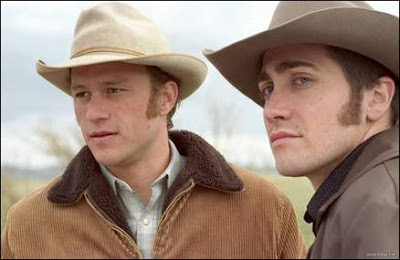
It came out today that Heath Ledger died of a foolish overindulgence in downers. This tragic death reminded me of an exchange that my friend J.C. Gaither had with Roger Ebert when the Oscars snubbed the obvious winner of their award two years ago. I asked Jim if I could run his letter here as I have long admired it, and he agreed.
He was responding to an article by Ebert in the Chicago Sun-Times defending the selection of Crash over Brokeback Mountain. Ebert responded, and when I get a copy of that response, I will add it below. Here's Jim:
_______________
March 9, 2006
Dear Mr. Ebert:
I am taking the extraordinary step, for me, of writing to you concerning Sunday night's Academy Awards. I saw your appearance on Leno Monday night and read your response (in the Chicago Sun-Times) to the backlash over the "Crash" Best Picture win. I, too, believe that you, and other like-minded critics, are dead wrong in your appraisal of the relative merits and lasting importance of "Brokeback Mountain" and "Crash." I hope that you will indulge me briefly while I put my thoughts about these two movies into my own personal context:
I was born in 1944 and graduated from high school in 1962. My father was a ranch-hand and I grew up on a series of citrus and walnut ranches in Ventura County--before it had become simply a bedroom community for L.A. My life on those ranches was filled with the usual experiences of a rural childhood: caring for a range of livestock and learning to operate farm machinery long before I could legally drive on the road. Unlike Ennis and Jack, I benefitted from an excellent public school education and was able to enter U.C. Berkeley in the autumn of '62. Despite living in San Francisco, continuously since 1969, I did not come out as a gay man (to myself first, then to family and friends) until I was thirty years old.
In the years since my coming out, I have patiently waited for an affirmative representation of a "regular" gay man in a quality film and have not found it--until now. To be sure, there are any number of gay "presences" in film: the limpwristed, lisping stereotypes that straight America is so fond of--or, more accurately, so comfortable with. If the characters aren't of the requisite swishy clown variety, then they are most likely dying of AIDS, or in the case of the equally popular "gay psychopath," seeing to it that other people are dying. Finally, a movie appears that portrays the gay world as I know it through personal experience. My gay world, over the years, has been peopled by military officers and enlisted men, gardeners and Greyhound bus drivers, military and civilian pilots and the full range of professionals from all fields. And, yes, one real, live cattle rancher from Montana! Never, along the way, have I hung out with the makeup artists, hairdressers and choreographers that seem to exclusively populate the psyches of standup comedians--and many movie critics.
The easy acceptance of Philip Seymour Hoffman's excellence as the drug-addled, profoundly flawed Truman Capote stands in stark contrast to the simultaneous slighting of Heath Ledger's superb, understated performance as a gay man "passing" and trapped in a mutually unsatisfying heterosexual marriage. It is evidence of an ugly truth of today's society: American entertainment will tolerate, and even reward, portrayals of gay characters so long as they stay in their traditional roles. Stray from those roles and, to paraphrase Ennis, you're dead!
It is no longer socially acceptable, in "civilized" circles, to blatantly denigrate black people in the television and movie industries. It is highly acceptable to viciously caricature and demean gay people. The hallowed tradition of "coon" humor in popular entertainment has been replaced by "fag" humor--and it is unrelenting in its ubiquity and viciousness. It is in this prevailing atmosphere of socially-sanctioned gay-bashing that Leno, Letterman, et al. reduced the heartrending tragedy of "Brokeback" to the nightly smutty joke and sold the false characterization of the movie as nothing more than "cowpokes in chiffon." The absolute nadir of this pile-on was staged by none other than the (apparently) deeply troubled and self-loathing Nathan Lane with his "Brokeback Mountain--the Musical" skit on Letterman. Well, the campaign of ridicule seems to have paid off--at least as reflected in the voting of a majority--however slim--of the Academy voters.
I have a question or two for you: Were the Best Picture Awards bestowed in Venice, Berlin and at the BAFTA Awards simply "political correctness" in response to some nebulous pressure exerted by the "gay agenda" aspirations of gay Americans? Do you really believe that the "message" of "Crash"--that we are all, no matter our racial or ethnic affiliations, capable of the same blind, prejudicial assumptions about all others who are not "us" and are thus, alike, capable of great, unthinking cruelty and injustice to one another--is fresh, unexplored territory? I submit that anyone who has lived in a multiracial, multiethnic community like San Francisco--or Chicago--knows all of this only too well. The theme, in one form or another, frequently appears in movies and on television. For me, "Crash" is a totally topical and transient commentary on our particular time and place and will have a very brief shelflife. On the other hand, "Brokeback Mountain" is a story not set in our time and one that I believe will prove to be timeless.
The reason that it resonates so strongly with those who have bothered to see it (listen up, Larry David) is that its portrayal of the importance of "following one's heart," even in the face of certain societal disapproval, is one that audiences of all sexual orientations can understand and respond to with profound emotion. The utter, hopeless aridity that life offers Ennis at the end of the movie is a "message" that most people can, and do, respond to at every screening and in every venue. Long after "Crash" has joined the ranks of "Traffic" as a forgotten movie of the week, "plucked from today's headlines," "Brokeback Mountain" will go on, breaking hearts and illuminating the dark, sad places to which frightened self-denial can lead us all.
Best regards,
J.C. Gaither
San Francisco, CA
Monday, September 10, 2007
Sweeney Todd, The Demon Barber of Fleet Street
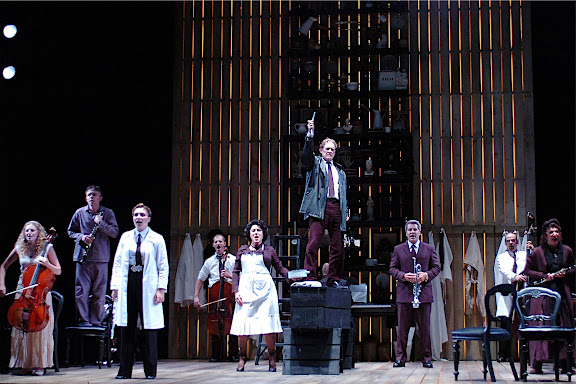
Just a quick note to say that the new American Conservatory Theater production of the Sondheim classic is a mind blow. As I have noted before, my critical abilities in music pretty much stop and start with what I like. So, I like it. I like it a lot.
What do I like about it? Well, the music is just transfixing. Ya gotta wonder if this Sondheim guy ever did anything else ... hmmm. It was jarring and seductive. It had me on the edge of my seat and recoiling at the same time. And how can you not thrill to a performance where the players sing and play instruments and move like cats on a crowded stage, and act to boot. Every time the fetching Tobias put his 17th-century violin down on the stage, I was terrified that someone would step on it. But like a bunch of pixies, this spectacular cast sashayed around the obstacles and came to attention on a dime, ready for the next number. Cellos flew from hand to hand, clarinets appeared from nowhere, trumpets exploded, and the violin became a fiddle and then a violin again all within a phrase. The one loose horsehair in the violinist's bow dazzled in the pointilist lighting.
That horsehair was attached to the puckishly pranching and froggily leaping Edmund Bagnell as Tobias who plays a sly and uncomprehending narrator to perfection. The superbly professional and riotously funny Judy Kaye as Mrs. Lovett dominated the set and sutured the actions into one breathing bloody bossy bold protoplasm of a play. I thrilled to the classic tones of Lauren Molina as Johanna and the eery Diana DiMarzio as the Beggar Woman ... you want to ignore her, you want her to go away, but she insists and insists, and turns the play on its head just when you least expect it. David Hess as Sweeney Todd was dark and demonic and obsessive ... sort of like a Hummer owner turned loose on an innocent planet.
But the most overwhelming part remained the dizzying choreography. For a sports fan, it was like a protracted bootleg where misdirection creates waves of action all over the field. I'd see the thing again just to watch the movement. Of course, the music enchants ... it drowns you in its creepiness and its sinister drubbing. So how could even the practiced fan stop his mind long enough just to watch the motion.
So that is lavish praise. And I really liked it.
Friday, June 29, 2007
The Imaginary Invalid redux
 My notes on farce last night were a little bland, frankly. I do think that the identity/mocking dialectic provdes a lot of the charge in farce, but the notion of farce as antidote is a little flat. So I want to play with another idea by starting with the simultaneity of identifying with the farcical character and mocking him ... in other words, participating in mocking oneself as one is reflected in the character with whom we ironically cannot help but identify.
I think that the root of this simultaneity is in a rhetoric of deception. So a little terminological set-up:
Rhetoric is the art of manipulation of the relationship between author and audience. In that art, neither author nor audience are fixed or singular concepts. Both shift both in terms of their biological or real being and more so in terms of their representation and play in the text. Manipulation, then, in rhetoric is never singular ... it always involves simultaneous manipulation of both sides of the pairing, each of which is at least multiple and ... being coy ... multifarious.
Multiple, in this sense, points to the author being a real person when he wrote the text, and a real person after he wrote the text, and an implied or represented person in the text, and a reflected or perceived person when the text is experienced by its audience. And, multiple points to an audience that walks into a theater and watches a performance, or reads a book, and that is also implied or represented in the text, and that is often recreated or predicted or defined in the text through the vehicle of an internal audience who witnesses the action.
Multifarious is multiple but more so; it points to the possibility that each of these authors and audiences can change within a performance or a reading or the length of a novel or story. Perhaps I use multifarious in too coy a manner, so I found a couple of definitions (skip to the next paragraph if you want the short version): "uniting usually in an improper way distinct and independent matters, subjects, or cause" [Dictionary.com. Merriam-Webster's Dictionary of Law. Merriam-Webster, Inc. (accessed: June 29, 2007)] and "1593, from L. multifarius 'manifold,' from multifariam 'in many places or parts,' perhaps originally 'that which can be expressed in many ways,' from multi- 'many' + -fariam 'parts,' perhaps from fas 'utterance, expression, manifestation,' related to fari 'to speak' (see fame)" [Dictionary.com. Online Etymology Dictionary. Douglas Harper, Historian. (accessed: June 29, 2007)].
Having credentialed, let me paraphrase: uniting in an improper way distinct matters through manifold utterances. Well that, it turns out, is the essence of farce. I am certainly not saying that all rhetoric is farce, because there are many rhetorics dedicated to other purposes. But all rhetorics involve selection from multiple possibilities, and that selection always has the possibility of deception through elimination as well as deception through copious or overlaid saying. In the case of farce, the eliminated choices are obvious and open, even stated, and they are replaced in statement or utterance by additional overlaid and contradictory utterances. So what the farcical character does is to obscure the obvious and state the obscure. He does it baldly. Soon enough, he will be hung by his own petard, as it were, and we will laugh at him. But in the end, the farcical fool ends up with the last laugh if only because he carries on, or because the obscure becomes the obvious. Argon starts as patient, and ends as doctor to himself as patient.
In the Imaginary Invalid, the scene opens with a man obsessed with his medicines and his pains and his fears, and yet his actions belie his words and fear. He pines for his doctor, threatens to marry off his daughter to the doctor's fool son solely to have a doctor in the house, and then ends up by becoming a doctor himself. As I said yesterday, I think that the American Conservatory Theater performance pulled it off. I should add that Anthony Fusco's performance as the scheming notary, Monsieur de Bonnefoi, and as the truly twisted apothecary, Monsieur Fleurant, was exceptionally pleasurable. The notary, attached to the gold-digging evil wife, schemes and manipulates; but he is a bad guy and is eventually chased off and humiliated. The apothecary, however, embodies our fears and our vicarious hopes ... he is the mean man with the enema, yet we can openly hope that the enema is delivered and we can take pleasure in the discomfiture of poor ... well not so poor ... Argon. Fusco made a fabulous evil enema-dealing apothecary.
But every step on the way in this farce is a peculiar representation of deception ... whether Argon deceiving himself, or his wife is deceiving him, or his daughter is deceiving herself, and so on. And meanwhile, the author is deceiving us because he constructs characters again and again who are not who they seem to be, but they are, and we know it, but we pretend we don't so we can laugh.
Farce is a rhetoric of deception that is unusually open about its purposes and its methods. Part of its allure is that the author's toolkit is on full display. I am intrigued by the idea of a rhetoric of deception in every text, and I hope to return to it frequently. But starting with farce, I think, allows us to look at the elements of deception with exceptional clarity.
So those elements include an author with multiple purposes, an audience hoping to be deceived but reserving its savoir faire and savvy, characters who are not what they seem, and devices in the author's toolkit such as that juxtaposition and reversal to which I allude in this blog from time to time.
I plan to return to this theme in thinking about the movie C.R.A.Z.Y. when I get around to watching it again.
Click here for my previous post on the Imaginary Invalid.
Photo by Arod, down by Fisherman's Wharf


