
Always a little late the party, I managed to bring myself to see Avatar over two nights this long weekend. Each viewing was accompanied by a pair of martinis, and chicken on spinach or cauliflower. When the roommate leaves, me eating habits become elemental, and my drinking habits alternate among martinis, bourbon on the rocks, and Liberty Ale. It;s a reduced life, but the solitude is pleasant. In that mood, I climbed the stairs to take advantage of my upstairs neighbor's absence to use his Hi-Def TV for my Avatar experience.
I don't like adventure films, and I define the genre broadly. They seem contrived, and because they rarely are based on genuine psychological portraits, they tend to employ cheap plot tricks whose only point is to induce thrills in those who enjoy the suspension of disbelief. I have no problem with that ... I am not trying to be a snob. I just don't enjoy this particular set of cheap thrills. Of course, my reductions here are informed more by extrapolation than by filmic experience. I have probably choked my way through fewer than a dozen "adventure" films in my life. I couldn't force myself to watch the third Lord of the Ring after almost ripping my hair out watching the second ... "will this never end" I quacked. I did enjoy The Shining, but you know how long ago that was.
So I came to Avatar a skeptic.
And I left a skeptic also. That said, I quite enjoyed it.
But first the good part. The special effects, even without 3D,were fabulous. But what I would want ... and I recognize that I am in a tiny minority here ... would be a steady state, plotless, anthropology-style excursus on life on an alien planet. All the drama and the cheap plot just get in the way of a perfectly lovely fantasy.
So to the cheap plot. One wonders why Mr. Cameron employs such a thin kitbag of character stereotypes. Tuf and gruf, goofy but likeable, balsy female pilot, hero with a heart of gold but confused. Of course such banalities of character loom as Einsteinian relativity beside the single-digit algebra of the native population. It is a curiosity that liberalism prefers to depict primordial or universal religion in terms so reminiscent of the popular representation of Native American religion that I expect a pow wow to break out. And indeed, eventually one did.
Notwithstanding the central action of an improbable battle in which arrow-firing cavalry brings down a massive modern air force, and notwithstanding the underlying theme of the struggle of nature against technology and the fight of primary extractors against the military/industrial complex, I think this is fundamentally a religious film. The society of the natives is riven with religion, and indeed nature itself on Pandora is religious in its geo-biology. Not too much intelligence is spilled in constructing this pantheon ... there is a simple pantheistic god and lots of mystical communicating via trees and dandelion seeds and what not.
I am sure that most people came for the adventure and the special effects. I wonder what they make of the pantheism. Is it just that this sort of religious prattling is common in scifi? Or do they just not care.
A recent states that fully 18% of Americans no longer profess a religion. I suspect the figure is actually radically higher, but most people like to pretend they have a religion because it is generally thought to be expected. That Avatar's religious message exacted so little chatter is a sign to me that the religious debate in this country is controlled by that tiny array of fanatics who strike fear into those who would say the emperor is nude. Many more Americans are actually pantheistic quasi-animists than would admit or even know it. I think that is why the religious content of this movie provokes so little discussion.
Religion and war go together of course, and so too in the movie. But while the religion presented at least had some intellectual pretenses, the military stuff was a joke. I mean, cavalry in a jungle. 2,000 troops are all they could muster? And suddenly firearms appear without apparent explanation.
But that too, I suppose, is part of the adventure genre. It is not about the sense of it, nor is it about the factors or the psychology. It is about setting up the action and then riding it.
I enjoyed the ride, but I could not suspend disbelief. I'm waiting for the documentary.
Photos by Arod, from Quane Alley, I believe.
Monday, May 31, 2010
Notes on Avatar


Sunday, July 27, 2008
My Winnipeg
Went with Christopher and Paulo to the San Francisco opening of a new film by Guy Maddin called My Winnipeg. It's a dreamy introspection worked around what the narrator describes as yet another attempt to flee the town in which he has lived for his entire life. He is on a train and much of what we see is projected through the window as the train rolls endlessly along. The cinematography is rough, black and white, choppy, raw, new footage mixed with old. Certainly avant garde, but compelling and demanding rather than aloof and evasive. I wrote a few quotes down as we accompanied Maddin on his flight, as we tried to flee with him.
How can one live without one's ghosts?
This is a film about memory, and its vagueness, and how it deceives and traps us. How you can only try to run away, but even in flight you are already heading back. Even at the end of the film, we do not know if he escaped, or if he really tried to escape. We know that he doubled back on himself and found a way to release himself from his self-made vow. But we do not know what happened, or indeed if anything happened.
Whatever happened only took 80 minutes to happen ... I appreciate a film that says what it has to say promptly ... but it was a long, drawn out 80 minutes. It seemed like two hours ... and I say that not with fatigue but with the entrancement of fixation. He didn't even lose me with his long riff on the travails of hockey rinks and hockey teams in town. He let go for a moment of the dreamy quality of his narration and got a little fevered ... though the dreaminess returned with the phantom hockey teams of aging stars.
The breath freezes in front of your face and falls to your feet with a tinkle.
You have to feel for a place like Winnipeg. It is truly lost in the middle of the continent. From a distance it is a haze of winter breath, vague, unknown, not on the agenda. But it is, more than any other city in the Canadian prairies, a real place with a history that mattered, with enduring cultural institutions. As the world collapses on itself, and as everything turns into suburbs and commodities and the latest thing, Winnipeg gets even vaguer, even less there. And this film accepts that vagueness. It lives entirely in the chill of the winter where, and I can attest to this, the crunch you hear as you walk is as much your breath as it is the snow under your feet.
I lived in Winnipeg from the summer of 66 to the summer of 68; I was in grades 9 and 10. I knew about this film only because Christopher told me when I told him that I have been planning a vacation that starts and ends in Winnipeg. When I lived there, I loved the winter. I rose early, even though I was in my young teens, to walk my dog Laddie in the dark and snow and freezing cold. I still dream about Winnipeg. And my dreams too are about being trapped there, even though I am not trapped there any longer.
Who gets to vivisect his own childhood?
Maddin took this film as an opportunity to revisit his childhood by reconstructing its key events. He got Ann Savage to play his mother, and he rented part of the house in which he grew up. Who gets to do that? He states in the film that Winnipeg has a law that everyone must carry a key to every house they have ever lived in ... were that the case, I would have quite a weight of keys. When we left Winnipeg in 1968, we were in a car on our way to the train ... not sure if it was a taxi or what, but my Father had left earlier and was already in Toronto. Mother asked where was the dog ... we looked around, and he wasn't there. So we had to head back to the house ... 181 Oak ... to get him, and the new tenants had already arrived and were examining this great placid beast who would not budge. We didn't need keys. Imagine, though, being able to stage that scene again, to pick the actors who play your family as it appears through the fog of years.
A little indulgent, perhaps, in the wrong hands. But in Maddin's hands, the scenes are haunting and elusive, foggy and alluring. 
Everything that happens in this city is a euphemism.
Early in the journey, the film turns on sleepwalking ... Maddin asserts that Winnipeg is the sleepwalking capital of the world. Sleepwalking is a purposive vagueness, adroitly performing actions without knowing what you are doing. Zombie-like. Sleepwalking, I suppose, is the euphemism for enduring the torments of life, for growing up when we are so conscious and yet so out of control ... so totally in a situation that we do not know how large or small it is. The Maddin character is vaguely sleeping or dozing on the train ... here he is in full flight form everything he has known, but he cannot rouse himself to attention. Sleepwalking into freedom. Does he ever arrive?
Maddin is a classic unreliable narrator. Down the street and around the corner from where he lived is the Sherbrook Pool. Maddin claims that it is the only pool in the world where there are three pools built one on top of the other, that the bottom two were closed in 1966. I bolted up when he showed the pool ... because I had my bicycle stolen from in front of that building in the summer of 1967. A terrible day that pierced my innocent sense of right and wrong. I never got the bike back, but I did get trip to the police station to look at recovered bikes.
I didn't know about the three pools for the very good reason that there never were three pools; it's pretty clear he uses the stacked pools as referent for the Indian belief that there is another confluence of rivers beneath the confluence of the Red and the Assiniboine which is at the heart of Winnipeg. You never can know what to believe in this film, so it is the easier, and more fun, to give up at least as long as you are in his snare. The frozen horse heads are true ... and as I search the backrooms of my mind, I seem to recall that I knew about them. It's a great Winnipeg story ... a bunch of horses bolt from a fire in early winter, fall through the ice on the river, and are trapped, frozen to death, their heads projecting through the ice for the rest of the winter. The stuff about the gay mayors and the hot dude shows at the Golden Boy Club are at least partly true. But homeless people are not confined to rooftops in Winnipeg.
I guess all the rambling ends up with this: Guy Maddin is still confined, and so are we all. Confined not to memory but to memory's tricks, its deceits, the way in which it undermines truth and leaves us vulnerable. Confined to where we know who we are sufficiently that we can sleepwalk through the every day ... and confined sufficiently that even when we try to escape, we fool ourselves into not quite making it. Home is where memories are frozen in the ice, and yet where they sublime into an ether in whcih we are doomed to sleepwalk. That My Winnipeg for ya.
I do plan to return to Winnipeg, and I expect to use viewing this film as a goad. This is the plan: fly into Winnipeg in October, rent a Prius, drive to Ottawa, stay for five days to visit with my sister who is making one of her periodic pilgrimages from her home in Queensland, then drive back via the northern route (Hwy. 11) and spend another couple of days in Winnipeg. Lots of photos and blogging.
Nice interview with Guy Maddin here. Cleaner copy of the trailer here An intelligent reflection on the film here.
Wednesday, July 23, 2008
Watch Yer Mood, Dood

So, I've been in something of a black mood, as anyone who has suffered through my last few posts will know. Not unusual for me to be in a bad mood in July because this is the month before I go to press with the course catalog at the major research university (MRU) which pays my bills. The stress level gets titanic ... it is not just the pressure of chasing down all the myriad details and confirming that everything is true and grammatical and spelled correctly. It's more the maddening blizzard of email ... the dozens of requests for information that I have securely stored on my web site. For crying out loud, some people send me email asking me the location of a building where I am holding a meeting. Duh ... look at a map. I edit about 2500 course descriptions ... when I am done they are like little materialist koans, all tight and intertwined and thick with content. I cannot bear flabby prose, and in this job I get to root it out.
So I get a little crazy.
I am a little less stressed because, for perfectly rational reasons that are too particular to worry about here, my big boss decided that the book can arrive 2 weeks later than in previous years because we are going live with a web site the day that class registration opens. That means a 10-day press-date reprieve ... I kept saying it was like having a death sentence commuted to life no parole. I was giddy. 10 extra days makes the whole thing a piece of cake. So I am taking tonight off .. .really, an evening off in July is pretty rare in this journey.
And I am a little lighter of mood. Light enough to muse that blackness of mood appears to the natively pessimistic as simply absence of the dross of happiness ... the absence of the illusion that things are on some level okay. So I am not withdrawing from the bleakness of some of these last few posts, but rather affirming that there is something to be said for finding a little joy despite knowing.
So to find a little joy, yesterday I took my lunch hour to watch the first half of The Wild Parrots of Telegraph Hill (I am working mostly at home) and watched the rest of it before I fell asleep. It is about a remarkable man, Mark Bittner whose gentle intelligence is the other motif of the film ... i.e., other than the spectacular images of the parrots. The film is about Mark the drifter who found a temporary home, more like a squat, in a ramshackle cottage on Telegraph Hill after a couple of decades of bumping around North Beach like lots of other over-the-hill after-the-fact beatnik types. (For those not from San Francisco, North Beach is only slightly north and not a beach at all. It is in the shadow of Telegraph Hill where the parrots roost and feed, and it is the fabled home of the beatniks of the 50s.) From this shack he established a relationship with a flock of Cherry-headed Conures, and later wrote a book and was the subject of a film by Judy Irving who he later married and with whom he is now living in the gardens of Telegraph Hill.
So things turned out well. Notwithstanding that there is a chilling interlude in the film where this frigid middle class married pair slowly manages to choke out that they are tossing this unique man out of the little shack where he had been living rent-free. The pair is so slimy, so assured of their privilege. What ensues is heart-wrenching. Mark has to give up the wounded parrots he has rescued and nurtured to a rescue group. He has to say good bye to his avian friends including the unique Connor (I think) who is of a different related species for the rest. He has to move in with human friends in the East Bay ... San Franciscans shudder when someone has to move to the East Bay. We watch as his shack is demolished, and then we see the suburban "architectural" monstrosity that replaced it and the for rent sign.
What would it have taken for those peacock-proud middle class homeowners ... obviously rich enough to buy the most prime real estate in San Francisco and then renovate it from top to bottom ... what would it have cost them to make a little space of Bittner, to be the patrons of this kooky San Francisco legend? Would it have in any way substantially reduced the vast excesses that are theirs? Of course they don't have to. But that is the difference between the San Francisco of memory and the increasingly suburban greed that crowds in and destroys the very reason these people came in the first place.
At least those creeps get to live the rest of their pampered lives in the shadow of that ignominious exposure of how shallow run their souls.
It makes me think of the middle class again ... another sampling of the same middle class whose passivity and satisfaction and indulgence enabled the extended livelihood of the Junkers who led Germany and Europe to disaster in 1914. Now we all want to be middle class ... by "we all" I mean the entire species except for the infinitesimally tiny minority of the super-rich ... and I am lucky enough to be one of those who are middle class. Great work if you can get it. But we are no more than ostriches if we do not examine the unresolved contradictions of the middle class ... the tendency to equate their own comfort with good, the failure to use the gifts they are given, the casual rationalizations. In the modern American context, reduce it to this: the planet is going to hell because middle class Americans figure they must drive monster SUVs or their children's lives will be forfeit.
But prices must be paid. And the dread of those prices is hard bedrock of pessimism.
See how easy it is to work back from a little glimmer of happiness to underlying despair. But it should also be easy to work the other direction. If you look at Mark Bittner's site now, he is a happy man ... married, writing, living on the same Telegraph Hill from which he was so callously evicted. He has been a vocal defender of the wildness of the flock which only he tamed and then only for the few moments that the flock granted him.
This post has been written in three sittings, and by that it is probably a little disjointed. If some respite from my present travails presents itself, I will search for some photos from Telegraph Hill. Even better, I will walk the dog there on Sunday morning and take some new pix.
Thursday, February 07, 2008
Brokeback Mountain
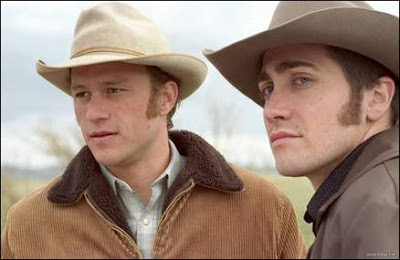
It came out today that Heath Ledger died of a foolish overindulgence in downers. This tragic death reminded me of an exchange that my friend J.C. Gaither had with Roger Ebert when the Oscars snubbed the obvious winner of their award two years ago. I asked Jim if I could run his letter here as I have long admired it, and he agreed.
He was responding to an article by Ebert in the Chicago Sun-Times defending the selection of Crash over Brokeback Mountain. Ebert responded, and when I get a copy of that response, I will add it below. Here's Jim:
_______________
March 9, 2006
Dear Mr. Ebert:
I am taking the extraordinary step, for me, of writing to you concerning Sunday night's Academy Awards. I saw your appearance on Leno Monday night and read your response (in the Chicago Sun-Times) to the backlash over the "Crash" Best Picture win. I, too, believe that you, and other like-minded critics, are dead wrong in your appraisal of the relative merits and lasting importance of "Brokeback Mountain" and "Crash." I hope that you will indulge me briefly while I put my thoughts about these two movies into my own personal context:
I was born in 1944 and graduated from high school in 1962. My father was a ranch-hand and I grew up on a series of citrus and walnut ranches in Ventura County--before it had become simply a bedroom community for L.A. My life on those ranches was filled with the usual experiences of a rural childhood: caring for a range of livestock and learning to operate farm machinery long before I could legally drive on the road. Unlike Ennis and Jack, I benefitted from an excellent public school education and was able to enter U.C. Berkeley in the autumn of '62. Despite living in San Francisco, continuously since 1969, I did not come out as a gay man (to myself first, then to family and friends) until I was thirty years old.
In the years since my coming out, I have patiently waited for an affirmative representation of a "regular" gay man in a quality film and have not found it--until now. To be sure, there are any number of gay "presences" in film: the limpwristed, lisping stereotypes that straight America is so fond of--or, more accurately, so comfortable with. If the characters aren't of the requisite swishy clown variety, then they are most likely dying of AIDS, or in the case of the equally popular "gay psychopath," seeing to it that other people are dying. Finally, a movie appears that portrays the gay world as I know it through personal experience. My gay world, over the years, has been peopled by military officers and enlisted men, gardeners and Greyhound bus drivers, military and civilian pilots and the full range of professionals from all fields. And, yes, one real, live cattle rancher from Montana! Never, along the way, have I hung out with the makeup artists, hairdressers and choreographers that seem to exclusively populate the psyches of standup comedians--and many movie critics.
The easy acceptance of Philip Seymour Hoffman's excellence as the drug-addled, profoundly flawed Truman Capote stands in stark contrast to the simultaneous slighting of Heath Ledger's superb, understated performance as a gay man "passing" and trapped in a mutually unsatisfying heterosexual marriage. It is evidence of an ugly truth of today's society: American entertainment will tolerate, and even reward, portrayals of gay characters so long as they stay in their traditional roles. Stray from those roles and, to paraphrase Ennis, you're dead!
It is no longer socially acceptable, in "civilized" circles, to blatantly denigrate black people in the television and movie industries. It is highly acceptable to viciously caricature and demean gay people. The hallowed tradition of "coon" humor in popular entertainment has been replaced by "fag" humor--and it is unrelenting in its ubiquity and viciousness. It is in this prevailing atmosphere of socially-sanctioned gay-bashing that Leno, Letterman, et al. reduced the heartrending tragedy of "Brokeback" to the nightly smutty joke and sold the false characterization of the movie as nothing more than "cowpokes in chiffon." The absolute nadir of this pile-on was staged by none other than the (apparently) deeply troubled and self-loathing Nathan Lane with his "Brokeback Mountain--the Musical" skit on Letterman. Well, the campaign of ridicule seems to have paid off--at least as reflected in the voting of a majority--however slim--of the Academy voters.
I have a question or two for you: Were the Best Picture Awards bestowed in Venice, Berlin and at the BAFTA Awards simply "political correctness" in response to some nebulous pressure exerted by the "gay agenda" aspirations of gay Americans? Do you really believe that the "message" of "Crash"--that we are all, no matter our racial or ethnic affiliations, capable of the same blind, prejudicial assumptions about all others who are not "us" and are thus, alike, capable of great, unthinking cruelty and injustice to one another--is fresh, unexplored territory? I submit that anyone who has lived in a multiracial, multiethnic community like San Francisco--or Chicago--knows all of this only too well. The theme, in one form or another, frequently appears in movies and on television. For me, "Crash" is a totally topical and transient commentary on our particular time and place and will have a very brief shelflife. On the other hand, "Brokeback Mountain" is a story not set in our time and one that I believe will prove to be timeless.
The reason that it resonates so strongly with those who have bothered to see it (listen up, Larry David) is that its portrayal of the importance of "following one's heart," even in the face of certain societal disapproval, is one that audiences of all sexual orientations can understand and respond to with profound emotion. The utter, hopeless aridity that life offers Ennis at the end of the movie is a "message" that most people can, and do, respond to at every screening and in every venue. Long after "Crash" has joined the ranks of "Traffic" as a forgotten movie of the week, "plucked from today's headlines," "Brokeback Mountain" will go on, breaking hearts and illuminating the dark, sad places to which frightened self-denial can lead us all.
Best regards,
J.C. Gaither
San Francisco, CA
Wednesday, January 23, 2008
Heath again
 Don't the Oscars ring awfully hollow every time you hear "the Oscar-nominated Heath Ledger." He was robbed by homophobia. Who remembers the film that won? Brokeback Mountain was a love story, certainly, but at bottom it was about the closet and how it destroys lives and tortured souls. The Oscars understood, and embraced the closet rather than this now gone, fabulous actor and his film.
Nice appreciation in the New York Times by A.O. Scott here. My earlier post on his death here. A Salon piece here, and my friend Jim Gaither's correspondence with Roger Ebert on Brokeback Mountain and the Oscar's here.
Tuesday, January 22, 2008
Heath and Moors
 Heath Ledger's numbing death reminds me of Pip, of Dickens' Great Expectations.
Ours was the marsh country, down by the river, within, as the river wound, twenty miles of the sea. My first most vivid and broad impression of the identity of things, seems to me to have been gained on a memorable raw afternoon towards evening. At such a time I found out for certain, that this bleak place overgrown with nettles was the churchyard; and that Philip Pirrip, late of this parish, and also Georgiana wife of the above, were dead and buried; and that Alexander, Bartholomew, Abraham, Tobias, and Roger, infant children of the aforesaid, were also dead and buried; and that the dark flat wilderness beyond the churchyard, intersected with dykes and mounds and gates, with scattered cattle feeding on it, was the marshes; and that the low leaden line beyond, was the river; and that the distant savage lair from which the wind was rushing, was the sea; and that the small bundle of shivers growing afraid of it all and beginning to cry, was Pip.
"Hold your noise!" cried a terrible voice, as a man started up from among the graves at the side of the church porch. "Keep still, you little devil, or I'll cut your throat!"
A fearful man, all in coarse grey, with a great iron on his leg. A man with no hat, and with broken shoes, and with an old rag tied round his head. A man who had been soaked in water, and smothered in mud, and lamed by stones, and cut by flints, and stung by nettles, and torn by briars; who limped, and shivered, and glared and growled; and whose teeth chattered in his head as he seized me by the chin.
The fearful man was Abel Magwitch, a convict, who repays the kindnesses of young Pip with a fortune later in life. The fortune was earned in Australia whither Abel Magwitch had been condemned before returning to see the smile on the face of the young man whom he had helped. No smile though, for Pip was most aghast at the revelation that his benefactor was one so low.
In the face of death out of the blue, we are each one of us Pip .. afraid, suppliant, willing, retiring. What recourse is there against cruel untimely death.
Ledger could have played Magwitch, or he could have played Pip. He was that plastic. In either event, he is descended as are most Australians not from the Pips but from the Magwitches. Perhaps the allure of the Australian is that Magwitchian temperament. But in this sad moment, not to think of such fancies.
My memory of the young Heath is this. It was Christmas 2005. The careful reader will know that I imbibe much from Christmas, and use the season to skate on emotion, and freeze that emotion lest I forget in the intervening madness of the long year of making a living. For several such seasons, I had noticed the rise of an allergic reaction to something in Christmas ... I have since deduced that it is the cedar I bring into the house ... and I sought refuge from my sinuses one rainy day between Christmas and New Year's in a long drive. I went to my old haunts at Cal in Berkeley, abandoned of its normal denizens for reasons again of the season. I wandered about on the campus of the nourishing mother in the rain, and then headed north in the East Bay, picking my way across the Richmond-San Rafael Bridge which soars past the depths of San Quentin, and then I zig-zagged down through Marin County to Mill Valley. And, lo, Brokeback Mountain was showing at the famous local theater. So, on a whim, I bought a ticket and settled in. You must realize, here, that I never go to the movies, that I loathe the crowds, and that I prefer my own company to a bunch of yappy popcorn-eaters. I also avoid the movies because I prefer to suffer the emotion that great art induces in solitude, and in control of the pause function, so that I am the more immune to the wash of sorrow and fear.
I shushed a couple of yappy ex-sorority gals, and settled into Heath and Jake. The performances left me without air, drained. Heath dancing with the clothing of his deceased lover ... I live in a house filled with the memorabilia of the army of friends I have lost to the plague ... it was love and longing and the impossibility of living without dread and anguish. From my groin, it was Jake I loved; from my heart and gut, it was Heath.
The next evening, my oldest friend Frobisher dragged me out of my isolation to a movie at the Sony Metreon. But, alas, Frobisher had misread the newspaper, mistaking a.m. for p.m., and whatevver froth we had envisioned was not available. The only movie left was Casanova, starring, ta da, the young sexy Heath Ledger. What a romp! Farce and the comeuppance of the self-righteous and a bunch of sexy repartee. What does not please here!
So, I ended up going to the movies two days in a row after not having ventured into a theater for over a year ... and both starred Heath Ledger.
Now, without a hint of a warning, he is gone. It reminds me of the emotion of when River Phoenix died. Both were keepers, men who would have grown into depth and vigor unike the frothy nothings who populate People magazine. I have never recovered from River Phoneix' death, and I think I will never recover from the passing of Heath.
Death and the gonads ... it is not that one harbors some realistic hope of a trist with a Heath. Rather, it is that he represents some ideal of the glory of the male erotic. Not strident, but nuanced. Not a stomp but a song and a dance. Not rage, but a dance of irony and joy and play and strength.
When we mourn our cinema heroes, we mourn our hopes, our faint dreams. I want to be Casanova. I wanted to be Heath. No longer.
When I was a boy, I wanted to know Pip, I wanted to wander with him on the moors. I wanted to suffer with him, exult with him, settle with him. Heath was Pip, and I wanted to know him as the sad man left alone in Montana, and as the prancing dandy in Venice ... but now he is Magwitch, a cadaver, gone, dead. Gone dead. Too sad.
Further short reflection on Heath here, and my friend Jim Gaither's correspondence with Roger Ebert on Brokeback Mountain and the Oscar's here
Sunday, October 21, 2007
Blogging Vancouver: Nighttime Tomfoolery
Let's do this in reverse.
So, after the interminable trailers and loud commercials, we settled in to watch Elizabeth: The Golden Age. Given the reviews, I was not expecting much. The visuals were, by halves, great ... that is to say, when the movie was not mucking around in the uninteresting details of Bess, the lady in waiting, there were some nice scenes. Pity that they were historically so feeble. As Frobisher pointed out, she did not live a church. I do not believe that she ever dressed up like Joan of Arc in armor on a horse and gave a speech to the troops waiting to be slaughtered by the Spanish. Mary's execution, so dramatic in the film, was actually botched and they hacked her head of with multiple blows. And the notion that Walter Raleigh single-handedly fired a ship and then jumped into the English Channel presumably to swim back to shore safely is laughable. And whether old Queen Bess was an emtionl wreck or not is not nearly as interesting as how she managed to rule for so long and with such success.
So historical inaccuracy is only part of what drives me nuts. I think history is drama enough, and mucking up with tawdry love affairs and feelings of betrayal just makes it so ... so cheap. Now why would anyone want to make a film cheap? The answer is in the hideous experience of going to a multiplex.
Now they have multiplexes all over the place, and I did not need to come to Vancouver to endure one. But dear Frobisher and AW, my hosts, are more socialized than I am, and they not only knew about the movie's location, but also how to get there, and what to do when we got there. I'll skip the parking garage nightmare on Burrard Street. But how can I skip the pigsty aesthetics of the multiplex ... garbage everywhere, cheap architecture gussied up to pretend to more than it is, broken toilets, sullen unkempt staff. And rackety customers. Cranky!
But that is par for the course. What really boiled me was the endless trailers. We got there early on the theory that the show would be sold out. So we saw every bleeding one of the things, as well as ads for toothpaste and monster trucks, exhortations not to pirate movies and to throw your garbage out. By the advertised start time, we'd had our fill ... but, noooooo ... 15 more minutes of this endless captive torture. No wonder I avoid movie theaters like the plague. Yes, very cranky.
I suppose part of the crankiness was in response to a rather bad Greek meal at one Simpatico's on 4th Avenue that advertises itself as purveyors of cuisine in the Greco-Roman tradition ... just what would that be, now? I suppose it means carelessly prepared Greek food and substandard pizza on the same menu. I can only guess about the pizza, but my souvlaki was fast-food good, AW declined to eat his calamari dinner, and Frobisher choked his way through a couple of vinegary appetizers. The not-very-Greek waitress didn't like us ... we were obviously not going to drop a bunch of money and get drunk and leave a big tip. At least she moved us through the experience at a fast rate.
Greek food comes in two types, with no room in between ... good and bad. The good is prepared with care with good ingredients ... funny, that ... and the bad is based on the assumption that if you paint the palce blue and say "retsina" once in a while, people will eat anything. The worst restaurant meal of my life was in a Greek place in Amsterdam. Last night, the good Greek place had a line out the door. So we ended up Simpatico. Worse than we bargained for.
But other than all that, it was a fine evening ... good company with no end of the ribald sarcasm for which we hold ourselves famous ... we did shut up for the movie, though, but that is only because we are Canadian-polite
Monday, September 03, 2007
Four Days
It's been a lovely four days off, and now the hours fade and it is time again for the routine. I am sitting at the kitchen counter, a Planter's Rum Punch in hand courtesy of RL, my inimitable bartender and roommate. I can face "the routine" only because I am practiced at it. If I think about it, well, it becomes a nightmare. But why think ... just drink.
As we drink, a few thoughts ...
Further thoughts on that old fag, Mr. Craig: IM, my oldest and best friend, suggested today that I add the frankly obvious note that the man was clearly entrapped. Tea room sex, as it is properly called, is not exactly new. Laud Humphreys wrote about it in his seminal (if you will pardon the school boy pun) Tea Room Trade. The essence of what we can know is that when Mr. Craig tapped his foot, he only proceeded to rub his hand along the base of the divider because the good sargent tapped his foot. We have mutual foot-tapping, people. Those who do not foot-tap will suffer no further inconvenience. By reason of this pas de deux, we are all saved from a closet queen fascist and now Idahoans will proffer a standard 'publican hypocrite. We can only assume that the new Senator has been vetted for unassailable heterosexuality ... and by that I am not suggesting that he dressed up in a diaper for a New Orleans hooker like certain impeccably heterosexual Senators evidently did ... of course, in that case, there was no guilty plea so all is forgiven.
A few films populated this long long weekend: As I have mentioned before, decades of not being cinematically inclined have made for pleasant, if unnerving, surprises. I caught a PBS screening of Witness for the Prosecution on Friday night. Nothing much to add to what is undoubtedly a large web of commentary other than to say that the whole film is Charles Laughton. On the closet theme, of course, Laughton was evidently gay, at least by the testimony of his wife who plays the comic nurse in this piece. At any rate, it was an entertaining two hours notwithstanding the excessive focus on the courtroom. Strange to see how forthrightly the plot develops notwithstanding the length. Modern films sometimes want to languish, almost as if lingering proves the auteurishness of the auteur. The stagier Billy Wilder keeps it at a reasonable clip. All you have to know going in is that there will be plot twists and you pretty much figure it all out. Loved Marlene Dietrich, but then I'm an old fag ... smile ...
And then there was The Queen which I finally saw last night. Again, not much to add to what has been said. Helen Mirren is the queen ... you never for a moment doubt that the real flesh 'n blood queen is there on your TV screen. The rest of them are good enough, and Tony Blair is a believable portrayal even if he never convinced me that he was a prime minister. But Helen was all she wrote, and all that you need to know about the film. As a 50-something Canadian living amongst the primitives, and one who was fashionably anti-monarchical and an unfashionably ideological socialist those decades ago, it is with some sheepishness that I admit that I have come to admire the old queen. A bit like religion I guess ... there is no truth in the myths, and considerable danger in the hierarchy, but the occupant of the institutional chair gives you a certain warm security ... like a pocket warmer or a pair of knit mittens. I thought she came out well in the film, and in a definable sense the film is a defence of the monarchy. Note that the "victims," Diana and her boys, are not acted but only portrayed in news footage or by anonymous actors seen only from the back. They are not real ... Mirren is real.
BTW, Charles got the bum's rush; he is actually a lot more substantial a man than portrayed. Put it this way, in the fairy tale sense: if Diana had been an old hag with a big wart on her chin to whom Charles had been forcibly married, and if Camila were a wee slip of a lass devoted to her man and he to her, then this would be a fairy tale romance. But Camilla is a horse and Diana is a glass slipper, so Charles has to play ugly, and this has become the ultimate fractured fairy tale.
Another museum: My newly minted membership to the de Young also admits me to the Legion of Honor. And so on Sunday, I headed out there to see Rembrandt to Thiebaud: A Decade of Collecting Works on Paper. Spectacular. Pity they produced such an underwhelming catalog. Museum hounds salivate over catalogs. I'm sure it is a losing proposition economically, but any great exhibit deserves a lavish publication for the devoted to devour. Anyway, a couple of notes on particular pieces ... I'll try to fill in the bibliographic details in the next few days ... and I will add a few more after dinner ...
White Horse in Baghdad, Christopher Morris, 2003. Low horizon, almost sepia colored. A tank with a crew in Baghdad in the background, and a white horse galloping down a road, going gawd nose where. The horse, dirtier in color than the sky, seems to gleam against the gloom of its surroundings. As I look at it, the horse seems to recede from reality, as if it cannot really be there. Barely visible against the backdrop of a low wall, two trios of men, walking abreast with their hands on their heads.
I ended the weekend with my favorite walk with Loki along Fisherman's Wharf and back through North Beach. Perhaps more on that later ... the important thing is that ... this is a post ... and dinner is ready.
Photos by Arod.
Tuesday, August 21, 2007
Barry Lyndon
Couple of notes on Barry Lyndon which I watched because I have been rereading some material on the Seven Years War ... what my American compatriots call the French and Indian War.
This is a curious movie because it does not appear to be concerned that none of its characters are in any sense worthy of empathy. I am not well versed in criticism of Thackeray, although the Wikipedia article notes that the film substitutes an omniscient, impersonal narrator for the books's highly unreliable first-person narrator. Pity that. Not sure how he handled the warmth of his characters.
I enjoyed the movie, especially the scenery and cinematography. It seems to center around a number of episodes of corporal punishment, unconvincingly acted and, again, not eliciting any sympathy or even emotion. In the scene depicted below, I could not determine if I was more unconcerned about the brutish Barry Lyndon or the insipid Lord Bullington.
So, unconcern can be amusing especially if the scenery is pretty. This is not one of the pretty scenes.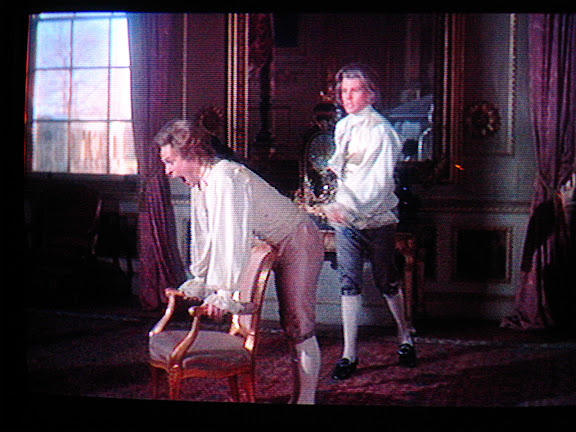
Friday, June 22, 2007
Evocative Vocative Disambiguation
I kept wondering why the film is called Sebastiane when Sebastian's Latin name would pretty clearly be Sebastianus. Then it struck me that this is the vocative ... O Sebastian. The vocative case of a second declension noun in -us is -e. So the name of the film addresses Sebastian, and this supports, I would argue, the notion that the film is really about Severus as a stand-in for the audience. He/we cry out, O Sebastian, and then we arrow him.
Other posts on Sebastiane:
More Thoughts on Sebastian
Sebastian: Patron Saint of Gay Men
Thursday, June 21, 2007
More Thoughts on Sebastian
I am reminded in thinking about this film of the arguments of the fabulous Cal Professor Carol J. Clover in her explosive Men, Women, and Chainsaws who, to reduce an argument far beyond what it deserves, achieves the association of the intended audience not with the victimizer but with the victimized ... she argued that the young men who love slasher films are not vicariously murdering women, but rather vicariously becoming women who are murdered or, in the case of the heroines, threatened with murder. Let me pause to say that anyone who loves structure or argument in fiction or performance needs to visit Carol Clover's work. I'll get back to why she comes to mind in thinking about Sebastiane.
This film is about Severus. Remember that Severus is the blond long-haired, fabulously sexy commander who ties up and tortures Sebastian, but cannot bring himself to rape him. The film is about Severus because he is the subject of Sebastian's erotic and unattainable objectness. As subject, as actor, it is Severus who cannot penetrate, that is to say he cannot be active, and ends up by substituting the arrowing execution for his impotence. The impulse to activity is reduced to impotence by nothing more than witnessing the Christian in his refusal of body, sensuality, and the old gods.
The film when it appeared was deemed "controversial" because of the saturated male nudity (only one erection, by the way, which the British censors excised, as it were) and the open and positive expressions of male homosexuality, a first by many reckonings. Most common critics seem to focus on this controversy, but the controversy really amounts to nothing more than one part of a doubled deception by the auteur, Jarman. Both the controversy and the covering provided by the only apparently positive portrayal of a Christian saint obscure the penetrating insight into what Christianity actually meant in the late empire, and how in the end it succeeded in destroying its foes and compelling them to its will. So when you think about this film, ignore the pseudo-controversy, and confront the layered deceptions of authorial intent.
One central deception is that we think the film is about Sebastian. But he has only one action in the film ... to be or have become a Christian ... while Severus continually confronts his impotence, his inability to assert his due authority, his failure to take the one he wants, and the fact that that failure transmogrifies into desire. When he states that he loves Sebastian, it is only because he cannot have him, and he cannot have him not because Sebastian actively forbids it, but because Sebastian's passivity undermines his activity. Sebastian in the middle of being tortured passively intones that Severus can never have him and never did have him. Christianity is about denial ... denial of passion, eroticism, human contact.
Here again, Jarman represents Christianity in action before the state, in the form of Constantine, adopted and transformed it. The action is passive ... Christianity bears witness but does nothing. It forces the cults and the practices and the orgies and every activity of paganism both in its moribund classical form and moreso in the new mystery cults that arose in the vacuum of dessicated Roman religion ... it forces them slowly to come round to it. It does so in the same way that Sebastian ensnares Severus by his sublime passivity. This is the great insight that Jarman, both by his weak narrative and his strong structure, communicates in this consuming film. Christianity won by its sublime passivity. Later, of course, it consolidated its victory by ferocious activity, but this is not Jarman's project to elucidate.
It may appear curious that Severus does not appear at the execution; his final penetrating victory takes place in his absence ... and why is that? This is where the subtlety of Jarman's vision hides in plain sight. Because the absence of Severus proves the identity of the victim and the victimizer. For the audience who has been deceived into thinking that the film is about Sebastian whom they never can become, rather than Severus who they indubitably are, the absence of Severus at the climax allows the deception to achieve its effect. There is Sebastian, expiring and ecstatic, in agony and yet fading ... we want to be him, to take him, to absorb him ... but in that longing, we have become Severus, and his absence points to our being there in his place. The deceptive author has stripped him out of the action and forced us to be there. And in being there, we who are Severus cannot help but try to identify with the very Sebastian who has told us we cannot have him.
But the arrowing does not need us any more than any other part of the film needs us, and so it is quiet, impassive, lacking in the drama that any execution should naturally have. And that is because in the end this film is not about us, it is not about Sebastian ... it is about Severus and his world that Sebastian and you and I have destroyed by our infernal passivity and resignation and acceptance of that which ends up happening.
The double movement of denial, followed by denial of denial. We are not there, and we deny that we are not there.
Back to Clover ... "What makes horror 'crucial enough to pass along' is ... what has made ghost stories and fairy tales crucial enough to pass along: Its engagement of repressed fears and desires and its reenactment of the residual conflict surrounding those feelings ... just as the attacker and the attacked are expressions of the same self in nightmares, so they are expressions of the same self in horror film." (pp 11-12). Severus and Sebastian are the same. But Sebastian is unattainable, so we are stuck with being Severus ... desirous, frustrated, defeated, catharsized. And Christ, unnamed, "you'll never have me, and you've never had me." Christianity as the unattainable, bodiless, anti-erotic. See what we have lost, what has been taken from us. This is Jarman's genius.
Other posts on Sebastiane:
Evocative Vocative Disambiguation
Sebastian: Patron Saint of Gay Men
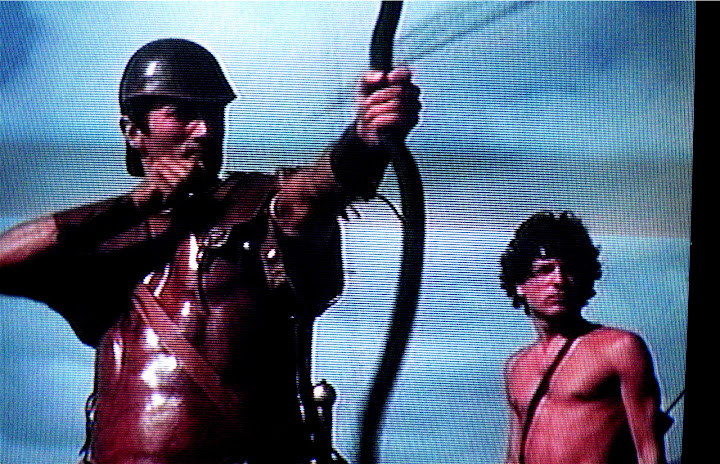
Both images from my TV, the first of the arrowing, the second the ineffable, unattainable Sebastian at his moment of denial.
Wednesday, June 20, 2007
Sebastian, Patron Saint of Gay Men
Thanks to Netflix, I finally watched Derek Jarman's Sebastiane last night, a compact 84 minutes of casual male nudity, conjunctural and committed homosexuality, and eroticized proto-Christian masochism. The plot is thin ... we know its broad lines going in, after all, so in that sense this movie is about the eloquence of the telling not the mystery of the outcome, using the terms of Kenneth Burke which I discussed with reference to McCabe and Mrs. Miller: "We cannot take a recurrent pleasure in the new (in information) but we can in the natural (in form)" ... the key word is recurrent, we cannot enjoy something again and again when it is focussed on the new rather than on the style or the form.
So let us start by looking at this film as form, not as plot ... as natural in the sense of the action occurring "as if" it does not need an audience rather than as openly contrived for a defined audience whose ignorance of the outcome and desire for entertainment is the force behind not merely the narrative but the fact of the film itself. What is that silly runnaway bus film with Keanu Reeves ... that sort of film is made with the audience in the foreground. Sebastian makes the audience squirm because it does not know if it is supposed to be present.
This seems funny in the first place because of the unflagging eroticism of the film from beginning to end. The first scene is a bacchanal in presense of Diocletian, the pagan emperor who unleashed the last major persecution of Christians before Constantine's decree of tolerance in 313. The ultimately cruel Maximus, one of those coarse jackasses who populate every workplace in history, tells us that he next saw the sublimely sexy and obviously homosexual Sebastian at an outpost to which both were assigned not knowing why. The bacchanal serves only to situate us where we do not belong, to remind us of the mythology of the Christian writing of history and to establish that the auteur sees no there there. It is an empty device, perhaps essential to reminding us that we do not need to be there, but empty in the sense that it does not matter to plot or to us, the audience for whom the author has no time.
Cut to a stone fortress, a rocky desert, an empty scene in which only the nearly always nearly nude soldiers appear. Except for the initial bacchanal, nudity is as natural and unaffected as the rocks in the desert in which Sebastian and his comrades are posted. They fight, and Sebastian refuses to fight. They gambol, and they make crude sexual insults. Male love appears without narrative motivation, as natural as the spashing water in the long, strangely clean scene of wet intercourse between serenely beautiful Anthony and Adrian until they are called away by Severus, the commander in the sun, who wants them to hurt the reluctant and homoerotically charged Sebastian. This is where we first see in its full articulation the play betwen the unsatisfied and lustful sadist ... Severus ... and the passive masochist, the Christian Sebastian. The commander stakes him spread-eagled in the blazing sun rather than raping him.
Christianity is the oddity, here, though it is certainly noble or rare or at least as refined and sublime as the long wrassle in the water. Rape too is natural, like the hot sun, burning, unpleasant, but known and inevitable.
Why is Sebastian a Christian? Why does he never mention Jesus by name? He refers to him as sublimely beautiful, as more beautiful than Adonis, as if he has substituted the unavailable beauty of the invisible unnamed Jesus for the pressing, insistent and ready-to-go beauty of Severus ... as if the new erotic god who cannot be touched supersedes the old gods whose worship always entailed touch and pleasure. Is Christianity, then, nothing more than frustration, the weakness of a character facing his own sensuality who transforms himself so that he has the strength to resist urges, pleasures? Why is Sebastian more sublime than the lovers in the water? Is it because he allows Severus to hurt him while the lovers allow Severus to bully them?
What is at work here is what I like to call the pretense of unselfconsciousness ... it is "as if" we would not notice when things turn into their opposite. You see, and there is no way around this in the film, Sebastian is as gay as anybody else, as wrapped up in his sensuality and his ability to allure as any of them. But he has slyly turned himself into his opposite. He is a gay man whose erotic force has reversed itself so that it is directed not toward the physical men who surround and desire him, but toward an imaginary figure whom he associates with the Sun. He frustrates his willing rapist, Severus, to the point where he can be martyred. And we are not supposed to notice; we are invited to pretend to feel the sorrow of his loss.
Jarman captured an essential fact of pre-Constantine Christianity, that it served in its history to metamorphose the fulminating movements of spritual and emotional change that roiled through Roman life in the second and third centuries, to transform them drip by drip back ino the empire. It took on the cults, overwhelmed them, and made them temporarily into a rebellious if unarmed Christianity, all the better to reharness them after Constantine to empire and dominance. Now, there is a teleology here ... that is, I am implying that those who operated before Constantine knew that he would follow, and this is false ... but Jarman argues from after the fact. His pretense of unselfconsciousness works because he knows what happened, and he allows Sebastian to represent in his martyrdom not the victory of Chrstianity but the defeat of the erotic.
The climax of the film for me is the torture scene in which Sebastian, tied arms over his head is pinched and struck and threatened and hurt by a Severus who ends up being impotent ... the impotence not apparent, but obvious by the fact that he does not rape his prisoner. Masochism triumphant, sadism humbled. Then the soldiers sitting around apparently torturing someone (I think I missed something here because I cannot identify for you the one with the crown of thorns and the wound in his side that the soldiers were hurting) and they are called ... "Sebastian is to be killed."
The execution by arrows is quiet, slow, the pain is on the face. He does not seem to die. The penetration hovers been life giving and film ending. He is an object of desire, penetrated, strung up, inaccessible, unavoidable. It is difficult watching this to distinguish between pleasure and pain. Is that what Christianity was? Did the martyr merely compress all the ecstasy into one auto da fe?
The film ends, and Sebastian is still an erotic object. The patron saint of gay men.
I will try to return to some of these themes in the next few days. I have been reading an essay on Hellenism and Heresy that dovetails nicely. Another weird connection is this ... Severus reminded me of the hippie who rejected me in Yellow Springs. That is a little juxtaposition and reversal.
Other posts on Sebastiane:
Evocative Vocative Disambiguation
More Thoughts on Sebastian
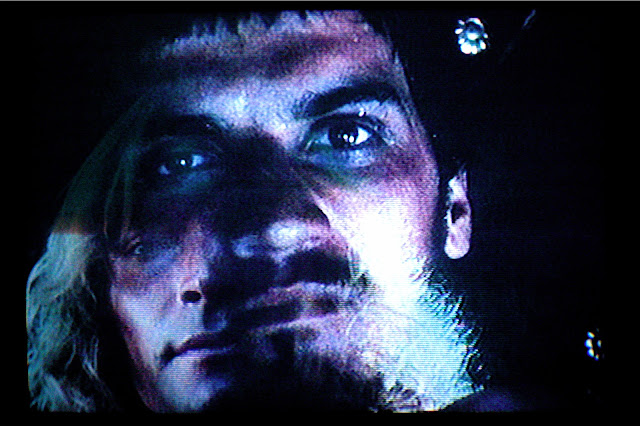
Both images from my TV, the top overlays Sebastian on Severus, the bottom is Severus.
Monday, June 11, 2007
McCabe and Mrs. Miller redux
 Had a few more thoughts about McCabe and Mrs. Miller today ... but first the personal context ... funny day at work as we are less than a week away from the biggest day of the year at MRU, and my big boss is retiring at the same time to great sadness for those of us he leaves in the saddle. He is a fine man, possessed of an obvious and evident stability and bearing that is a little more rare in the halls of the academe than one might expect. He manages to manage an executive administative post with the panache, intelligence, and flexibility that one expects from an academic and intellectual. Anyway, I doubt he will ever read this, so I can say unashamedly that I admire the man, and am selfish enough to regret his leaving us for the deserved relaxation of retirement.
But that has nothing whatsoever to do with McCabe and Mrs. Miller. There's another issue in this film, beyond the issue of eloquence which I addressed yesterday. Let me get to it presently.
When John McCabe first appears on screen, you know he's going to end up dead. But for two-thirds of the movie, the action moves slowly, languidly. The first killing develops out of nothing more than a pair of socks. It is shocking not because you do not expect it, but because it is so senseless; it is the more shocking because the murder is infused with sexuality, both of the recent visit to the whorehouse, and of the invitation by the killer that the presumptive victim strip off his socks. But the internal audience of townspeople, led and represented by the barkeep Sheehan, the Rene Auberjonois character, cowardly watch the action without protest or movement. The film languishes on the body of the dead boy, so recently running half naked among the whores, in the freezing water ... the observer keeps wondering if he will rise, if he is truly dead. The killer, a kid himself, has a face twisted by the presence of death. He coolly contrived a situation in which he could freely kill by duping the boy to pull out his gun. As soon as the gun is there, the bad boy shoots to kill. No one protests, no dialogue is wasted on explaining what is obvious but incomprehensible. It happened, it is over. No one retrieves the body.
That is the first of six killings in this little town which is both actually and literarily manufactured out of wilderness as we watch the film. None of the killings exacts comment, only one is witnessed by the spineless locals. The second killing, of the preacher in his temple, is shocking, brief, and over. The third killing, where the first killer gets his just deserts, is the closest thing to suspense in the film, but it too is over before it starts, and the body floats in another water, this time a vat. The fourth killing takes place through a window, and we do not even know for a long minute if the bastard is dead. And the fifth killing, of the assassin, is obvious, dramatic and fast. A derringer shot to the head, drops dead.
Again, none of this is witnessed. No one in this town, notwithstanding the burning church that is strictly a background action, a coloring of an otherwise ochre scene, no one notices that six men have been shot to death, that their bodies litter the streets. No one hears the shots. No one sees McCabe expire slowly in the snow, the only victim who did not die instantly.
In rhetoric, there is an idea called the implied author. See this as counterposed to the real or biological author. The biological author of the novel is Edmund Naughton. Perhaps we can say that the biological author of the film is Robert Altman, but it is also the producer and the actors ... a film has a committee of biological authors. The implied author is the author whom the observer can construct from observing. It would be a mechanical reduction to assume that the implied author matches the real author ... a real author can play the same sort of game with the implied author as he can play with an unreliable narrator. The implied author is a source of deception, of misdirection, of both innocence and complicity. The implied author is one of us, even is he is not of us. We observe, he pretends to create.
The curiosity of this amazing film is that the implied author is so passive, so uncaring, so unobservant. Live, die, what's the difference. There is no tragedy here. McCabe, who arrives in town exuding threat, turns out to be weak, confused, bamboozled. He has no chance, he never had a chance. Like a cur, he lives till he dies, and no one notices. The strangely flat Mrs. Miller is stoned on opium in a Chinese tent as the bloodshed mounts. She cannot care, she could not care. All that will matter to her is whether she can extract her 1500 bucks. But the film, the implied author, does not bother to tell us that. The implied author does not care.
This relationship between implied author and implied audience (which is to say us as we are predicted and implied and constructed in the text) drives this work, but the driving is weak, just like the townspeople, just like McCabe, just like Mrs. Miller. Six cadavers scattered around, and nothing matters. It reminds me of Auden's Musée des Beaux Arts:
Where the dogs go on with their doggy life and the torturer's horse
Scratches its innocent behind upon a tree.
What does this teach us ... do not innocently give in to the affect of the work of art, even as you resign to its conceits. For it is not only, perhaps not especially, the named author with whom we interact, but it is also a chimera, a falsehood, a deception, the author who never existed but who is created each time the text is experienced.
That is why I loved this film ... it left me weak, resigned. It made me a dog going on with my doggy life in a world I neither control not fully understand.
So I leave you with this thought ... this is precisely the Malay idea of pesona, often translated "enchantment". I will return to that on some future occasion.
Sunday, June 10, 2007
McCabe and Mrs. Miller
 I have more or less bypassed movies over the last few decades, and Netflix is allowing me to catch up. Watching movies often fills me with a little dread, and again Netflix allows me to watch the heavier ones in shifts, as it were, so that I can spread the dread enough to get through it without falling into a funk. And it also allows me to live in a filmic world over a longer stretech, and luxuriate in contemplating that world in between snippets.
In the case of Robert Altman's 1971 McCabe and Mrs. Miller, my friend JG more or less pressed it on me ... that is fine since I certainly need help in picking movies given that I have been absent from cinema for so long. He told me that Leonard Cohen, whom I adore and have worshipped since I was a teenager, did the music, so I managed to watch it in two sittings spread over a week.
I noticed that there is not much story, or leastwise that the story is not what drives the experience. Altman confirmed this in his commentary, saying that the story was not particularly well written, and contained so many stock elements that he knew that the audience would know, so he did not have to spend much energy as a director in telling the story. Instead, he could view the movie as a painting.
This approach is the essence of preliterate storytelling, more properly called radically oral storytelling or oral formulaic storytelling. This is the form of storytelling that has been the basic mode for most people for most of history. My dissertation was about a form of storytelling in the anicent Malay world in which writers wrote down stories intended to be performed for radically oral (that is, non-literate) audiences, and I treated of the problems of expressing complexity and contrarity in a language and form which was, formally at any rate, additive rather than recursive, to use the word my friend IM and I were discussing today.
I am a little tuckered out today consequent upon one too many Monte Carlos, a rye and benedictine drink, consumed last night to celebrate IM's return. So I will leave this brief thought about McCabe and Mrs. Miller by referencing my favorite literary critic, Kenneth Burke, on the subject of what drives the radically oral storyteller ... I think it dovetails perfectly with Altman's thoughts about his own work.
In his Counterstatement (1931), Burke wrote an essay, "Psychology and Form" in which he argues for a distinction in art between a psychology of information as against a psychology of form. He sees us having entered an age in which art loses sight of the psychology of audience and substitutes a psychology of information. He writes: "... the great influx of information has led the artist to lay his emphasis on the giving of information with the result that art tends more and more to substitute the psychology of the hero (the subject) for the psychology of the audience ... Proposition: the hypertrophy of the psychology of information is accompanied by the corresponding atrophy of the psychology of form."
Why do we watch Hamlet, he asks, even though we know the plot? He answers that we watch because of the eloquence of the performance, the form. "We cannot take a recurrent pleasure in the new (in information) but we can in the natural (in form)."
The suspense in a film like McCabe and Mrs. Miller is minimal, and once you have seen it a first time or figured out the likely direction of the plot, you can safely ignore the minimal suspense and luxuriate in the eloquence of the telling, of the form. I think a principle like this can be applied to Altman's work throughout, but I should probably do a lot more research before advancing that thesis with any confidence. McCabe does have a rather Hamlet-like make up.
That little essay by Burke influenced my thinking about art and storytelling more than any other single piece of writing. It really deserves a lot more exposure than it gets at this point. I will return to it frequently, I suspect, in this blog.
(BTW, it is curious also that Altman noted that the town was built as they filmed, and that the film was shot in scene order. That too dovetails with the additive nature of radically oral storytelling in which complexity is indicated by juxtaposition and reversal ... so as the story grows, the town grows, and as the town becomes more complex, so does the story. Again, more on these sorts of ideas down the road.)
Wednesday, May 30, 2007
Planet of the Apes and Religion and Rulership
Beware the beast man, for he is the devil's pawn. Alone among God's primates, he kills for sport, or lust or greed. Yes, he will murder his brother to possess his brother's land. Let him not breed in great numbers, for he will make a desert of his home and yours. Shun him. Drive him back into his jungle lair: For he is the harbinger of death. (23rd Scroll, 9th Verse)

Religion is always about power, whether the power to control and compel one's followers or the power to exclude the anathematized. It is a pity that we do not have more of the Ape Scrolls (quoted above) to play with, but this quote is good enough for a starting point. The psychology of religious political control is based on a dialectic of fear and submission. The sociology is based on the degree of force, whether armed force or the force of ideology as transmitted through social control, that religion can bring to bear upon rulership. As I tried to argue in my post about Gellner's take on the relations between Islamic piety and rulership, the Muslim relationship with power took place over a long stretch of history largely as an overt negotiation between an almost voluntarily subject pious urban population and a resident and tolerated "horseman" rulership.
The western Christian relationship between religion and rule is founded upon a long stretch of centuries in which the church was the centrifugal force, and rulership was a fractured centripetal force. Kingship did not arise instantly from the horsemen who drip by drip supplanted the Roman elites ... merging in some cases, dominating in others, and dropping almost instantaneously from historical view in yet others. Charlemagne stands out among the early definers of kingship, but even his famous coronation on Christmas Day, 800, was as much an attempt at episcopal usurpation for the purposes of the church as it was some sort of proto-constitutional establishment of the notion of divinely authorized kingship.
Even then, it was not until the 11th and 12th centuries that the church and the state settled into the pitched battles and fevered entanglements that set Europe on the path to its eventual liberation from the church ... a liberation that took another seven or eight hundred years to accomplish. What allowed western Europe to accomplish this was founded in the earliest moments of that relationship ... specifically, that the church had to confront rule as an alien force and not as a natural ally. It is exclusively in this sense that Christianity has a greater idea of the separation of church and state than Islam ... this idea is not in the theology but in the circumstances of the founding of modern Europe through the invasions of the horsemen at the expense of the Roman empire. Remember, theology is bunk, but religious history tells a tale that no one can sensibly ignore. Theology tail-ends events.
The proof of this paradigm is in the relative slavishness to power that one finds historically in the eastern church which was never free of the empire. Constantine dictated to the eastern chruch and this was a pattern that continued notwithstanding the various fights (for Arianism, for Monophysitism, against iconoclasm). The Byzantine church was an arm of the state. The western church sought to make the state an arm of the church, and in the event provided the venue in which the state eventually became independent of it.
That's my overview. It was not my intention in starting to write this blog that I would focus primarily on religious historical issues, notwithstanding that I have been reading almost exclusively for a year about the Middle Ages and in particular about the rise of Christianity. But having gone down this path, I thought it useful if only to me that I should put down the general lines of my arugment, and this is it. We shall see when I get back to it.
In the meanwhile, let's return to Planet of the Apes, a society in which church and state are fused. It is in that sense a fascist society, and that is the affect which the auteurs, if I might, used to inure the audience against its conceits. As much as rationalists rightly fear theocracy, we are not actually threatened by it at the moment in a Planet of the Apes type scenario, and the experience of the dubyaite cabal with the religious, and the speed with which it turned into bile, should frankly give us some comfort notwithstanding the hideous damage they have done. It is not that the bastards don't want to wrap us in a medieval cowl, it is that they still cannot notwithstanding that they are at their most dominant in a century. The religious have the upper hand in Planet of the Apes because they have a monopoly on the manipulation of fear, and it turns out to be an ancient fear that is well-founded. After all, Moses/Taylor/Heston ends the film wailing in the surf that human beings actually had destroyed themselves, and this "as-if" provided after the fact justification for the religious domination of rule in the society from which he is fleeing. The gift of this film, though, is that in the end we sympathize neither with the religious authoritiarianism nor with the rebel who is revealed as standing on sand.
Perhaps that is where we are now in society, recoiling at the religious madness but unable to find a hero.
Photo by Arod, Notre Dâme de Paris; click on the photo to go my Paris slideshow.
Sunday, May 27, 2007
Flux and Reflux: Planet of the Apes
I am still so pissed off about the paint job on the Hebrew Free Loan Association (see my immediately previous post); it is so galling when tiny minds or smug committees pollute the landscape with their witlessness. While I wrote that post, I flipped on the TV and managed to stumble on to The Planet of the Apes. Now, I am not much of a movie buff, though Netflix is allowing me to catch up (also killed some time today watching the hilarious A Shot in the Dark, the second Pink Panther movie), but for whatever reason, I have seen Planet of the Apes 4 or 5 times over the years.
This is a film thematically centered the relationship between religion and rule, often fought ought in a battle between faith and science. It is certainly curious of course that a bare-chested Charlton Heston represents the rebel for science and against faith. It struck me that the scene on the beach relates to my posts on flux and reflux in religion, and for that matter on the relationship between religions and rule that I wrote about in rehashing Constantine.
Dr. Zaius, who is a Jerry Falwell like cynical religious leader throughout most of the film, abruptly turns into a rather nuanced character on the beach. It starts when he says, "There is no contradiction between faith and science ... true science." This is a set-up line that played to rationalist sensibilities rising in public thinking in the 60s because what Zaius actually means is that true science is dictated by faith, not the other way around. So the audience was likely to see this as cynicism. Taylor (Heston) has no space for faith ... what he wants is a rifle and a horse (there are those damned horses again) and a shot at surviving by dint of brains and the quotidien application of reason to problems. Isn't it the more curious how that line about faith and science reads so differently in the present religious revanchism ... now true science is true faith, and butter does not melt in the mouths of those, be they the ludicrous creationists or the craven scientific apologists for religion, who claim that there is no contradiction between faith and reason. Nonsense.
But, as I say, this is a set-up line in the movie for a consideration of the role of religion. Remember that Zaius is the villain, and yet he argues that religion alone can prevent people (or apes, as it were) from enacting their worst instincts ... that without religion's deliberate suppression of knowledge, the worst instincts would come to the fore. Again, it is Moses ... I mean Charlton ... who snorts at this argument, only to learn the truth of it when he finds the shattered Statue of Liberty in the sands shortly thereafter. So the flux and reflux in the scene ... between Zaius as villain and Zaius as prophet ... mirrors the flux and reflux in the world between resurgent reason and the flight into faith.
Zaius ends up looking rather better than one might have expected as he threatens people with trials for heresy. I had to snort when the penalty was determined to be two years ... real religious history finds that the penalty for heresy is typically a horrible death or exile. Zaius's rehabilitation, however, stems from one of the most noxious of the religious claims ... not that they alone have truth, but that they alone have morality and depth of insight ... a brash rebel like Taylor cannot see that the fat establishment is protecting him when it denies him his freedom. So in his moment of subtlty, Zaius actually shows that he has harnessed his insights to repression and authoritarianism. That's theology for ya.
I'll try to come back to the question of religion and rule after I walk the dog.


