Showing posts sorted by relevance for query The Stillborn God. Sort by date Show all posts

Monday, October 15, 2007

The Stillborn God

I promised a while back to lay down Stephen O'Shea's exciting recounting of muslim/christian relations around the Mediterranean from the 7th through the 16th centuries to dive into Mark Lilla's recent The Stillborn God. During my "hiatus", I did just that ... well, at least half ways. (Click here for all my posts which have discussed this book.)

Half ways because I just had to give it up on page 124 of 309 pages of labored prose. I can say this for the book ... its turgidity is more annoying than its turbity ... by which I mean that it is more bloated than muddy, but not by much. This is the classic case of a modern book that any competent editor could readily reduce to a two-part New Yorker essay. Lilla indulges far too much meandering reminding his readers of introductory college humanities stuff that, he assumes, we have forgotten somewhere between spouse number two and SUV number three. But a tiresome review of the commonplaces of intellectual history is the least of the problems.

I suppose some sense of the impulse to completion will force me back to this annoying prose. But this is what stopped me in my tracks ... the Vicar is Rousseau's apologist for a de-theologized, or natural, religion in the famous parable in his Emile:

The Vicar's faith is not the Christian faith. But neither is it opposed to Christianity. That was what was so revolutionary ...


Revolutionary, indeed. Rousseau was exiled for this piece of writing, but I would assert that it was not because it was revolutionary but rather because it was an argument in the character of its times that threatened the perquisites of the cynical theologues who had the power to exile him. But in the grander scheme of things, this is precisely the apology for religion that allows the desperate to cling to it even in the face of "death of god." This was not atheism, but a pseudo-theism that allowed atheists to pretend to believe in god.

Early on in this blog, in the context of the good lord taking poor ole Jerry Falwell to his reward, I argued that there are three types of the religious: the earnest, the desperate, and the cynical. The Vicar's argument is the classic statement of how the desperate should interpret religion, how they too can join in.

Lilla's point in the long run is that secularists have to understand the mindset of the religious, and this is without doubt completely and totally obvious. But it hardly justifies forcing good secularists to plunk down $26 and hours of their free time to read through a turgid reiteration of "natural religion" arguments whose validity expired with the power of the Church to burn us alive, or leastwise chase us from our homes and livelihoods.

The straw man nature of Lilla's argument rears up even in the introduction ... the man seems to love cheap rhetorical tricks such as broadly obvious lines disguised as insight:

Fragility is a disturbing prospect. We see this in our children, who love fairy tales where occult forces threatening their worlds are exposed and mastered.


Good lord, children, fairy tales. But then he slides, as if the critical reader is blind to the obvious conflation, to describing "modernization, democratization, the 'disenchantment of the world,' 'history as the story of liberty'" as the fairy tales of our times. This is a set-up, a con job. Once you adopt this self-righteous dismissal of the themes of modern western civilization as mere fairy tales, there is not point in reading the rest of the book ... just skip to the mushy conclusion.

I guess this is as far as I can get tonight on this piece ... tired and back-sore. I am always annoyed by liberals ... secularists, if you will ... who feel compelled to interpret the idiocy of religion in a warm, fuzzy light. Religion was once ineluctable, unavoidable. It is now a curse. We need to find a way to obviate it, not to re-invest in it.

Call things by their real names.

I'll try to get back to hashing this book up on another, hopefully more lucid, occasion.

Wednesday, March 19, 2008

The Impostor

The tale of Lev Nussimbaum aka Essad Bey aka Kurban Said, and its competent telling in Tom Reiss' The Orientalist: Solving the Mystery of a Strange and Dangerous Life, throws into stark relief both the attraction of the impostor and the irreducibility of historical context in human lives. Born into a wealthy oil-magnate Jewish family in Baku (now Azerbaijan) on the shores of the Caspian Sea, Lev responded to the brutal reverses of the 1905 and 1917 revolutions, and then the rise of Nazism in the country to which he as exiled, by writing and re-inventing himself. Reiss writes:

For most of his life until fortune threw him to a place where he could no longer joke about such things, Lev would keep up a kind of comic dialogue with his writer friends about his "transformation" from Lev to Essad. It was not that he mocked his conversion or allowed others to. But among those he felt he could understand, and these were mostly his fellow Jews, he seemed to think it fair to reveal the transformation. With anyone else, he grew circumspect, neither denying nor accepting that he was covering up something. Rather than trying to refute anything, he responded by diving deeper into his identity and becoming more and more the Orientalist--more and more Essad Bey.

Remember transformation for a moment. I'll come back to that.

Many Jews of the late-19th and early 20th centuries adopted a stance as eastern, Asian, non-European, seeing in Muslim and other Eastern peoples kindred spirits opposed to the Europeans among whom they lived and who reviled them as conjunctures demanded. Lev was of this ideational caste, if you will, and as such might not precisely be seen as an impostor if we can accept that he genuinely converted to Islam and subsequently adopted a Turkish name. But he rewrote his past, and he dodged his present, and his religious system was always an act and never a belief. The identity came first and religion had to follow. That is a less rare pattern than one might imagine ... I believe it is precisely the pattern that has so many atheist politicians trundling off to church every week (does anyone with a rational mind believe that Hillary truly believes, or for that matter Obama notwithstanding his genuine earnestness?).

There was one exception to the precedence of artifice over belief in Lev, however. He was a genuine monarchist, a devoted follower of the dead Czar as well as the exiled Sultan and erstwhile Caliph. The historical background is that his life declined along with monarchy. But there is more to monarchism than nostalgia. It represents a pointed and deliberate false consciousness especially in a man as quick-witted and intelligent as Lev.

Monarchism is the worship of impostors. How's that? Monarchy is like religion in that any rational analysis reduces it to the nothing that belies it. What props up monarchs and gods is charisma and history and, again, irreducibility. To abuse the phrase of the day, they are what they are. So long as they hold power, they are powerful. When they no longer hold power they are windbags ... nothing more than the puffed up claims that surround them. To believe in them after their demise is affect because there is nothing to believe in ... the charisma has become a chimera.

For a man who constructed his life from whole cloth, monarchy conveys a sufficient reference to a reality in which the impostor can invest so as to create an imagined reality that is the imposter's stock in trade. Look back, young man, for the future bodes ill. It is in your imagined past, young man, that you can find the girding that will save you, nourish you, make you into what you can no longer be.

Again, Reiss writes:

He had had few friends growing up and had a precocious child's wariness of other children. Indeed, his passage praising absolute czardom begins with a short speech on why "I love old people, detest the youth"; the old are "calmer, cleverer, and more modest," and when the young turn their backs on them, as they inevitably do, they "must consequently fall into barbarism."

I love old people too ... like my father before me, I have always had friends older and often much older than me. As I get older, I tend to grouse all the more at the barbarism of intemperate youth ... notwithstanding the obvious fact that they are pretty wallpaper. That said, I have always been young ... by which I mean that I am impatient and revolutionary by nature. I do not brook idiocy and my definition of idiocy is broad and sharp ... I also enjoy oxymorons ... and I fail to understand why people are stuck and incapable of understanding history and necessity. The older people who are or have been my friends are young in that same way. And by turns, so many of the young about me are old in the sense that they accept what is given to them and look only for their own comfort. They bear similarity to the young of Lev's day I that they accepted what was given to them and looked for their own aggrandizement through a reductionist view of history. Our youth seem to have no sense of history ... time will have to tell whether that is a benefit or a torment.

What Lev saw in the old was that they understood transformation in a loose way, a clever way, modestly and with a smirk and a smile. What he detested in the young was their ideological fervor as he experienced it in the rise of the goose stepping youth of the brownshirts and the imperturbable murderers under red banners.

So, transformation. Impostors do transformations. They are loose about it. The con man smiles and draws you in. My father called one of my younger brother's best friends a "beloved infidel" ... the guy was an impostor, but you had to believe and you had to accept the letdown because you knew you had believed. You could not pretend otherwise. Transformation on some level is not being able to pretend otherwise.

There is another kind of impostor, the one who does fake-outs, and regressions, and bait and switch. The one who substitutes glibness and the snide for the con man smiles. What is appealing in the impostor like Lev is disgusting in the ideological impostor.

I speak, of course, of neo-cons and other such reductionist ideologues of contempt and self-assurance.

My readerly ride through the terrifying years of the 20s and 30s with Lev/Essad was a little easier than it usually is. I have always found the interwar period one of the most difficult in history to imagine because the horrors into which it descended were so unprecedented in scale. Did Lev's peers know? Did the cabaret people, the communists, the brown shirts, the working class, the street walkers ... did they have any inkling of the guillotine blade under which they lived, of the rapid drop into hell which the uncertainty of their lives portended?

In that vein, I sought out some reading on the development of thought and politics in the 19th century. I really want to read about German and Italian unification, but then I stumbled on Michael Burleigh's Earthly Powers. Sure, I thought, there's a meditation on how junctures arise in history.

Alas, the book is mired in the inability of the simple-minded to get beyond finding someone to blame. And who, do you suppose, would be at fault for both Nazism and Bolshevism ... why the Enlightenment, of course, not to mention pretty much anybody who lived before during or after the events and to whom one can paste the label "liberal".

The book was so nauseating that I could not get past page 44 ... I actually wrote "this is unreadable" at the bottom of page 39. The problem too often with the modern ideologue is that he cannot let himself resist snideness no matter how many opportunities are presented. Adjectives and asides and little sneers everywhere. So, speaking of the era of the Enlightenment, he writes:

Censorship, lax in practice but all the more resented in theory, as well as ferocious blasphemy and sacrilege laws, sought to compel orthodoxy. The philosophes tended to highlight the most extreme cases, often omitting crucial details that might have modified their starkly contrived contrasts. (page 30)

Elsewhere, he refers to the "several existing tendencies and novel developments that are known as the Enlightenment" (page 37) ... in other words, the great force that initiated the permanent decentralization of religion and idolatry in European life if

In other words ... and this is the essence of the weakly expressed thesis of the book ... Catholicism and absolutism were kindly forces that occasionally did naughty things, but really given a few more decades they would have led the world to a peaceable kingdom of goodness and light, and the awful liberals and Nazis and Bolsheviks would never have come to pass. If only those horrible impostors, the philosophes, had not mucked it all up. O for a good auto-da-fe ... where was holy mother church when we needed it.

Burleigh like all neo-cons is an impostor. They claim a connection to the past, but they sing a tune that makes no sense. They pose as monarchists or defenders of holy mother church (I have no proof, but I'll eat my hat if this guy isn't a revanchist Catholic). But in fact they propound a radical theory of the dissolution of democracy. They are not conservatives ... they are radicals who seek to enshrine an entirely new political elite who are beyond critique.

What a contrast is the transforming impostor Lev from the dissembling impostor Burleigh. Remember that things called by the same names are not by force the same.

Mark Lilla, who wrote the saddeningly sycophantic The Stillborn God: Religion, Politics, and the Modern West about which I commented here and here, wrote a "damning with faint praise" review in the New York Times. Lilla writes:

The utopians did not believe in God but they very much believed in religion. That is the truly novel development in the 19th century, and one which Hurleigh never manages to bring into focus: the less people talked about God, the more they talked and worried about religion. For the utopians, the revolution's defeat of the Catholic Church represented an enormous step forward for the human race, but also posed an unprecedented challenge. Once men thought themselves free from God they might think themselves free from one another, like elementary particles floating in the void. What modern, postrevolutionary society needed was a new religion, or a surrogate one, a system of symbols and ceremonies bringing individuals together without reference to a revealing, transcendent God.

There is so much teleology here that it is hard to swallow. Society did make some civic gods, and Burleigh blames all of that on the Enlightenment ... but history is never complete. So the fact that the first attempts at constructing a civil life without the stultifying effects of godliness were incomplete is hardly surprising. The fact that some of them were more bloody than anything that had come before is an effect of the industrial means at hand ... only a fool would wish upon us the medieval inquisition in possession of the tools of modern destructiveness.

Burleigh is just such a fool. In that, he poses as an impostor, for he is surely intelligent enough to know that there is no going back, and that his very stance is itself as much a daughter of the Enlightenment as is liberalism or socialism or agnosticism of what have you. So he pretends to this conservatism ... but it is a lie. No, for the neo-cons, there is much more afoot. There is a bloody reaction, the telling doom of their enemies, the victory of their snide asides.

Ooops ... now their hero is McCain ... how the feigning mighty are melting into dust.

I will try to return to the relationship of fascism and religion at a later point.

Tonight's drink is a Piña Colada, RL's very own recipe, as he says. And then, a hard day having been had by all, we followed that with an exquisite Blue Moon, this one slightly flavored with a little Marie Brizzard Parfait Amour ... which makes it just a little grapey in a carnavalesque sort of way.

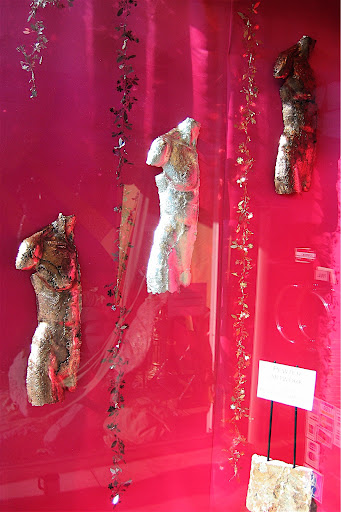
Photo by Arod of a window on Noe Street in the Castro.

Sunday, September 16, 2007

Postpostcolonialism

Sitting outside at the Cafe Flore, my long-time haunt, with only intermittent Internet access. Beautiful windy Sunday afternoon in the old town ... totally sexy young gay guy holding forth beside me on some sort of enthusiastic self-discovery theme. Like old times at the Flore in the early 80s when I sat here afternoon after afternoon consuming the battles of Napoleon, drinking too much coffee, arguing with passing fellow gay libbers, taking the sun in considerably less clothing than I prefer nowadays.

That's not why I am writing. I have been having a little trouble settling on a book to read ... sometimes these little interludes in reading can get protracted when you work for a living because the stretches necessary to devour a book do not present themselves daily.

[Overheard conversations are both alluring and annoying ... in a discussion of acting and life, the cute one is trying to defend the notion that notwithstanding artifice, there is a baseline of honesty which one cannot breach. His interlocutor is trying to defend the notion that a certain level of dishonety is necessary and not be bothered about. I'm with the cute guy. As this develops, I am more and more intrigued.]

So I tried mowing through Karen Armstrong's The Great Transformation: The Beginning of Our Religious Traditions, but it is all a little obvious and vastly too vast ... when an author disposes of the first three dynasties of Chinese history in 10 pages, and when I learn nothing from it ... well, it was just too boring. So I thought I would take a detour through Thomas Cahill's How the Irish Saved Civilization as a post script to having read Justin Pollard's richly rewarding biography of Alfred the Great: the Man who Made England. I heard Cahill speak last year at MRU (where I work) and he gave a riveting and entertaining off-the-cuff lecture about death. I subsequently read his Mysteries of the Middle Ages: The Rise of Feminism, Science, and Art from the Cults of Catholic Europe. He's great fun ... like being a culture-vulture tourist in history. But it slowly dawns on his reader that this is a great, long-winded, undeniably fascinating and well-written but nevertheless revanchist defence of Catholicism. It gets a little nettlesome, and evidently his craftiness was somewhat less subtle when he wrote the Irish book.

I am no fan of Augustine ... this will not surprise. I like to argue that two of the most disastrous lives in religious thought are Paul and Augustine who between them managed to muck up any possibility that Christianity might be liberation with their death-obsessed loathing of the senses. This is what Cahill writes concerning Augustine's flirtation with Manicheism:

For a while, [Manicheism] let Augustine off the hook ... it absolved him from any responsibility for his raging lusts ... it was a made-to-order religion for a smart young provincial who needed to explore every dark corner of the the boiling city and experience every dark pleasure it had to offer and at the same time think himself above the herd. But it couldn't keep up with Augustine's fearlessly inquiring mind. Like Jehovah's Witnesses or Mormonism, it was full of assertions, but could yield no intellectual system to nourish a great intellect. [my italics]


Ah, the conceit of the Catholics. Sublime. To paraphrase the Mohammedans, there is no system but the one system ... the Catholic system. Everything else is sterile. (I would certainly agree that Jehovah's Witness-ism and Mormonism are sterile, but that is a subset of the sterility of religion.) Then there is the knowing nodding about dark pleasures. What is so bloody dark about pleasure? Why do intellect and system and genius have to start with the rejection of the senses? This is an obscene conceit whose only proof is its own infinite repetition. And it is a little rich to imply that the "system" was in place when Augustine more or less invented the bulk of Catholic doctrine out of thin air and his own self-loathing. Christians in those days were a fractious lot who barely agreed on anything including, and especially, the nature of Jesus.

There is a lot of this sort of religious conceit about its own exclusive depth these days, and more intensely in the last little while. The obvious deadliness of religion in the current era is such that even the supine press has to note the rise in atheistic or secular revulsion at all of it. After each new atheist tome, there are various backhanded ... Cahillesque, if you will ... defenses of religion ... to whit, that morality is only possible with religion, that atheism is sterile, the poetry of the spheres kind of lunacy. And then there is the argument, which is at the core of Cahill's unadmitted defense of Catholicism, that European civilization is founded on Catholicism or Christianity, that there is no Europe without it, and by implication that we should be worshipful towards it.

I'll get back to this in a moment. But this rising debate between consistent atheists and secularized apologists for religion takes place in the context of a political period that I like to call post-post-colonialism. Among humanists ... terminology for delineating who we are talking about in these zones tends to be vexatious, but secondary, I think, to the argument ... among humanists, I think there is a rising but embarassing understanding that colonialism was a multivalent as opposed to a monolithic phenomenon. Colonialism was not an exclusively moral impulse, but rather the moral reflux that followed upon the history. That is to say that the long progress of European civilization put it in a position of rising power and military and technological superiority at a time when many of the places it conquered were in political torpor and all of them were technologically weaker. This historical judgment is not moral, but that is not to say that a morality did not flow from the circumstances, and that we can readily reject that morality after the fact ... that is, now.

But how do we explain the political, military, and technological superiority of Europe at the moment when colonialism's rather short reign began? Is it Catholicism, or Christianity, or the Protestant Reformation? Is it climate? Is it the millennium and a half of competing micro-states? Is it the Enlightenment?

An a propos review appeared today in the New York Times, "The Political and the Divine", a review of The Stillborn God: Religion, Politics, and the Modern West, by Mark Lilla ... you will have to read this right away, as the Times shoves everything into its vault after only seven days ... I know they are trying to make money, and I subscribe online precisely in order to have access to their vault, but it is a sad drag on the national conversation that everything in this flagship publication disappears in a week. Rebecca Newberger Goldstein starts by writing that "Some of us have been taking the European Enlightenment a little bit for granted." And she goes on to note, not without some sympathy, that Lilla argues that "Hobbes's thinking on the religious impulse [i.e., that it arises because man is a frightened ignoramus] [is] both historically pivotal and psychologically simplistic ... The religious impulse isn't merely a matter of man's cringing self-protective fear; it can also be an expansive response toward the universe, morality and freedom, and a strain of post-Enlightenment thinking, featuring thinkers of the caliber of Kant, struggled to do justice to religion's expansive aspects."

According to Goldstein, Lilla argues that the Enlightenment occurred only because of "Christianity’s own fundamental ambiguities — torn between a picture of God as both present and absent from the temporal realm, an ambivalence powerfully represented by the paradoxes of the Trinity — that made it 'uniquely unstable,' subject to a plurality of interpretations that became institutionalized in sectarianism, and hence to several centuries’ worth of devastating upheaval.” Goldstein has a lovely turn of phrase. In reference to this, she writes: "Or as I would less soberly paraphrase his point: Christian political theology encouraged the development of Enlightenment progressiveness the way that runaway mitosis encourages the discovery of cancer cures."

There's something here, of course. The Europe we know ... and the larger European civilization which through its bastard child, The United States, dominates the world, arose through, or leastwise in the company of, Christianity. But Christianity proved susceptible to science and rationality in a way that, straightforwardly, Islam has not proven itself, notwithstanding the monotonously reiterated fact that it once was more scientific than its contemporary Christ-lovers.

Here is where we return to Cahill. The fact that seculars ... the children of the Enlightenment ... need to contemplate the role of religion is not an entrée to a revisited Catholicism. It did happen the way it did, and we need to know and understand it. But that is not, ipso facto, an argument for a return to a church which, every day these days, proves what a decrepit wheezing old biddy it is.

[Alas, the fascinating discussion next to me ultimately foundered on the shallow shores of multiculturalism ... identity and background and colonialism and all that. The cute guy ended up being silent for quite a stretch as the studly other guy lectured him on how he should think. All the vitality of the discussion drains away ... cutey tries to start it up again by returning to his favorite word ... liminal. I want to chime in, but I am twice their age and cranky as hell. It eventually resurrected itself ... they are quite a vital pair. ... omigawd, cutey has an iPhone. The other guy is actually quite a stud, Brazilian, I think. It feels like they are cruising each other, but are lost in this by reason of the deep discussion. I've had that experience where the intellectual nature of the conversation makes it impossible to leap back to the sensual ... a bit like having Augustine sitting in on your moves. ... Eventually they part, but not before being certain that each of them plans to end up at Martini's at Valencia and Market. If I weren't such an ole fart, I'd go just to watch what ends up happening.]

Saturday, September 29, 2007

The Ineffable

I'm writing this post because I am going to interrupt my reading of Stephen O'Shea's engaging and impressive Sea of Faith: Islam and Christianity in the Medieval Mediterranean World about half way through ... we've just re-encountered the 1187 Battle of Hattin in which the Kurd Saladin more or less permanently put paid to the Latin kingdoms of the Outremer ... that is, he beat the Crusaders and opened the road to Jerusalem which he took shortly thereafter. I'm going to try to mow quickly through Mark Lilla's The Stillborn God: Religion, Politics, and the Modern West about which I previously wrote here. Descriptions of his thesis unnerve me a little. Even a casual reader of this blog will know that I am deeply suspcious of religion, consider it the root of all evil, and find religious hypocrisy to be the source of much of what ails us today.

But religion does not come from nowhere. First and foremost it comes from social power, and the so-called "world" religions derive from a relationship with the state as each evolves. But none of this denies that human beings are persistently ... what shall we call it ... "spiritual." And I want to address that before I read Lilla so that how his book might change me is the more evident if not to my reader at least to me. (I preface this promise to read with the proviso that finding time to read for a working stiff is a project, even for a working stiff with a love of books. I'll do my best to "mow" through the thing, but don't bother starting up a stopwatch.)


What we might broadly call spirituality is to me the encounter of the individual or the group with the ineffable. In the past, I found some utility in the decidely Christian work of Rudolf Otto in his Idea of the Holy, and especially his idea of the mysterium tremendum:

The feeling of it may at times come sweeping like a gentle tide, pervading the mind with a tranquil mood of deepest worship. It may pass over into a more set and lasting attribute of the soul, continuing, as it were, thrillingly vibrant and resonant, until at last it dies away and the soul resumes its 'profane', non-religious mood of everyday experience. It may burst in sudden eruption up from the depths of the soul with spasms and convulsions, or lead to the strangest excitements, to intoxicated frenzy, to transport, and to ecstasy. It has wild and demonic forms and can sink to an almost grisly horror and shuddering. It has its crude, barbaric antecedents and early manifestations, and again it may be developed into something beautiful and pure and glorious. It may become the hushed, trembling, and speechless humility of the creature in the presence of -- whom or what? In the presence of that which is a mystery inexpressible and above all creatures. [Oxford University Press, 1958 (originally published 1923), pp 12-13.]


When I was a graduate student encountering religion for the first time as an object of deep study, I was much taken with Otto. My great friend, Kurt Woodill, who was most assuredly anti-religious but by the same measure deeply spiritual, took great delight in long discussions of exactly what Otto has set out here. I doubt that I could have come to my present understanding of the spiritual without Kurt.

I think what Kurt expressed was that human beings have a deep ineluctable need to encounter the sum of forces that are beyond us. He saw it as a crossover of the animal and the human in us. So as we stand in awe of "the Universe," as he put it, we let loose of our human control over our environment and encounter on some level the acceptance that the animal feels.

From my earliest memories, I have looked at the night sky and let my imagination loose ... who is there, what is there? When I understood the concept of the light year, I imagined looking at a star who, when the light I was viewing left it, supported a great civilization that was at this very moment millions upon millions of years deceased. I remember contemplating my grandfather's death ... I was ten, his name was Arod ... and trying to imagine the difference from being dead for a moment and being dead for a thousand years. On the other hand, as it were, listening to the songs of birds sends me into a wordless torpor. I remember of moment of deep awakening one early morning 30 years ago in the rain in Vancouver when a Great Blue Heron, startled by my passing, flew up and past me no more than a few feet from my gaze. My heart trembled and I stopped to contempate the mystery.

Being of a scientific mind I can either explain or point to the explanation of others the meaning of stars and songbirds and the Great Blue Heron. But explanation does not reduce the feeling of the spirit.

But, equally, no religion is necessary to explain the feeling of the spirit.

I believe that religion is an assault on the spirit ... it finds the spirit at its most vulnerable and forces it to perform horrible acts, to reduce its possessor, to snuff out his freedom. It is not the necessary consequence of the spirit ... as Otto would hold ... but a cheap parlor trick in the name of the powerful and their perquisites.

Now, this is not to deny that there has been much beauty in the name of religion. The assault on the spirit that is religion leaves a void which the various religious traditions fill through their mystical subsets. The austerity of the Islamic religious impulse created the suffused oneness cult of Sufism, just as it created saint worship. Buddhism postulates a continuous and seamless hierarchy of understanding that goes from profane ritual to, as they enthuse, extinction. Buddhism is the perfect religion for an atheist, despite the current mass marketing of the Unitarian Universalists that more or less postulates that they don't care what you believe, just come on down anyway. Christian mysticism (and I exclude the rather more mystically inclined Eastern variety because I know so little about its particulars other than its long-time proclivity to craven slobbering at autocrats) seems a poor cousin, notwithstanding the mysteries of Mary and what not, and cathedrals with all those immoderately unmodern and decidedly un-Protestant gargoyles.


I'm an old hippie ... well not really. I once affected the style of hippies at their moment in history, but I was actually an activist, a politico, and it is a little remembered, or leastwise inconvenient, fact that hippies and politicos did not get along. That may explain some part of the discomfiture that I had in the left because I had hippie and lefto in me. That's not the point. The hippie movement championed the notion of spirituality without religion. The social untenability of that in the long-term led many of its adherents to drug addiction and to that most loathesome regurgitation of the 60s, the Jesus freaks ... and, on the more positive side, to new age religions and shamanisic revivals. The new age stuff in many ways has made accommodations with power, but the shamanists remain, in a sense, romantic outlaws.

The problem for a secularist ... and hold on to yer horses because you are about to encounter a little atheistic arrogance which, by the by, is nothing compared to the arrogance of the en-gawd-ed ... is that the boundless dimensions of human stupidity provide a fertile field for religious attack. So, yes, the spiritual. But how do we imagine a society in which spirituality has a full field in which to blossom but religion and its dark and murderous urges are viewed as no more than the bizarre imaginings of a tiny coterie of the certifiably insane?

RL, my sainted roommate and bartender, just handed me a 100 proof rye on the rocks withn only the tiniest spash of soda water. Spirits, yes, spirits. I note that my instinct, which is just a little more "religious" in this instance than I might prefer, is that if one splash is good, then two must be better. No gourmet thinks this way, nor would any deep-thinker. If I applied my underdeveloped culinary tastes to deep-thought, I would be a Christian ... pile on, pile on, make great hay over nothing more than chaff in the wind.

And thus it is with religion. It takes the subtle, the sublime flavorings of the spiritual as we encounter a Universe vastly more numinous than what we can describe, more expansive than anything we can imagine, and it turns those imaginings into coarse death-worshipping religion whose first impulse and last action is to crush the spirit and the person, freedom and the mind.

Notwithstanding marveling at the sky and the birds, I am not a particularly spiritual person, but I think I grok the musings of spirit. I just cannot accept the movement of spirit to religion, nor the theft of spirit by religion, nor the argument that spirit is only proto-religion. Religion is not necessary in the same sense for me that a ruling class is not necessary. Very difficult to imagine how to get there from here.

Gonna leave this now because I am running out of steam. I think I will go into the back yard and wait for the moon to rise.


Photos by Arod. The first two are from windows in the Castro; the third from a window on Grant Street in North Beach, the last from Balmy Street, the incredible art alley off 24th in the Mission.

Wednesday, September 19, 2007

Sheesh ...


Sheesh, I sure get hot under the collar quick when religion comes up. Thomas Cahill's reference to Augustine about which I wrote a few days ago got my back up, but I have cooled down. I left his Irish book by the wayside for a while and picked up something rather more to my typical taste ... Stephen O'Shea's lively review of "Islam and Christianity in the Medieval Mediterranean World" entitled Sea of Faith. And there on page 79, discussing the world after the fall of Visigothic Spain to the Muslims but also after their timely defeat by Charles Martel at Poitiers/Tours in 723 or 733, he writes this:

A commonplace of monastic chronicles and letters spoke of mundus senescit, the world grown old. That glum sentiment would have been deemed peculiar outside of western Christendom. The idea that a dying civilization was "saved," by the Irish of whomever, is parochial and would have been thought of as such by the denizens of the Mediterranean. By the yardstick of trade, intellectual inquisitiveness, and cultural interchange, civilization was doing quite well in the eighth, ninth, and tenth centuries, with or without the monks.


If I have a single impression from having spent a year reading medieval European history, it would be precisely that. (That O'Shea takes an obvious swipe at the nevertheless engaging and talented Mr. Cahill is just a pleasantry.) The fall of Rome was cataclysmic, but life went on with its wearying combination of battles, migrations, disasters, and death alongside quotidien joys and boredom and countless lives lived passionately and anonymously. Alas, I cannot deny, having considered the matter long and deep for fifteen years, that I consider the irruption of Islam to have been, on balance, a tremendous blow to humanity. But the clash of civilizations (is a liberal allowed to say that?) has certainly been fascinating, and it deserves the full attention of every worldly citizen. (To be ecumenical, I consider the rise of Christianity to have been a blow to humanity as well ... let's be fair.)

The disaster of Islam is not without its upsides ... carpets, music, Ibn Khaldun, calligraphy, chanting, the Egyptian middle class, Rumi, graduate studies. But this was a monotheism that stripped away the ambivalence so thoroughly that it had to invent Sufism as a stand-in for the subtlety that its dominant demagogues so expertly crushed with their recitations. Since I wrote that piece a few days back, I have not been able to get this out of my mind: "[it was] Christianity's own fundamental ambiguities — torn between a picture of God as both present and absent from the temporal realm, an ambivalence powerfully represented by the paradoxes of the Trinity — that made it 'uniquely unstable,' subject to a plurality of interpretations that became institutionalized in sectarianism, and hence to several centuries' worth of devastating upheaval."

I studied Islamic history for a decade, primarily in service of a dissertation on Islamic chronicles from the early Malay world. And it is a fascinating history, no doubt, but a history whose peaks are early and whose declines are long. There are no escape valves in Islam. When Muslims pretend to seek to return to the halcyon days of the rashidûn — the first three or four rightly guided caliphs, Abu Bakr, Umar, Uthman, and then the ill-fated Ali, the latter three of whom were all assassinated — they can actually pull up some texts that are reasonably unambiguous about what sort of stick to use to clean your teeth, and appropriate methods for lopping off a foreskin or a hand or a head. Christian fundamentalists, generally speaking, seek a return to an era no further back than a few decades or a century or two at the most. The early days of Christianity were filled with tornadoes of hair- and ear-splitting discourses about body and divinity and trinity, and the presence or absence of a single iota. Hardly a Christian alive can sort all of that nonsense out, let alone give you a reasonably accurate representation of Leviticus.

So the middle ages of Islam is a slow sinking into torpor, and the middle ages of Christianity is the slow rising of a challenge to its institutionalized nonsense. And modern Islam is predominantly a revelling in the torpor, and modern Christianity is a thuggish ignorance of its own history and those who have defeated it again and again. That's what I think ... and more historically minded western liberals than care to admit agree in some measure notwithstanding all the palaver about multiculturalism and acceptance and the truly moronic notion of Islam as a religion of peace.


I actually sat down tonight to write about Alfred the Great ... I have a post in my head that insists on being stillborn ... but this is what came out. Within a day or two, O'Shea is going to hold forth about one of the most important forgotten battles in history, Manzikert in 1071. I can barely wait, even though "our side" will probably lose again ... it has in every account I have read so far.

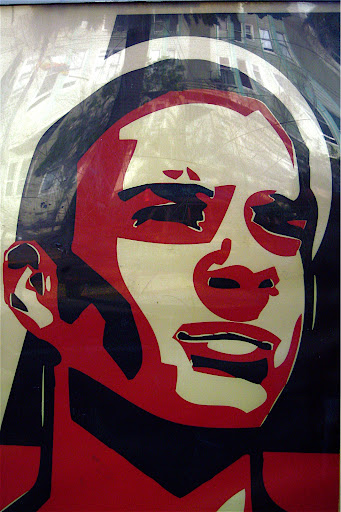
Photo at top by Arod; detail of a poster about town these days advertising the ill effects of methamphetamine. Not sure why, but the head seems a propos. Image below from Wikipedia Commons, depicts the battle of Manzikert; I believe that the Turk Arp Arslan is using the defeated Byzantine Romanus IV as a stepladder to mount his horse. Both would be dead within little more than a year.