Been playing with LibraryThing ... the obsessive-compulsive bibliophile's online toy. Tonight I entered a lot of
Kenneth Burke in my library ... my favorite literary critic. Bemoaning how little time a working stiff has to spend browsing in a lifetime's bibliographic gathering. So I looked him up in Wikipedia, and they had this sweet line": "Language, Burke thought, doesn't simply 'reflect' reality; it also helps select reality as well as deflect reality."
Not reflect, but select/deflect. Reflect is the first refuge of anti-dialectical thought .. the first refuge of common sense, the obvious, the easy. Select and deflect imply not just the obvious choice so much as the contradictory impulses of engaging and avoiding. Select/deflect imply choice and activity, engagement and intellect. They imply thought and abstraction. Reflection is passive and receptive. Select/deflect is activity and resistance.
Not sure where in the prodigious output of Kenneth Burke one would find his ruminations on these words, but this is what always attracted me to him ... engaging the artist, empowering the audience, demanding of the intellect.
More posts on Kenneth Burke here.
Tuesday, June 26, 2007
Kenneth Burke


Sunday, June 10, 2007
McCabe and Mrs. Miller
 I have more or less bypassed movies over the last few decades, and Netflix is allowing me to catch up. Watching movies often fills me with a little dread, and again Netflix allows me to watch the heavier ones in shifts, as it were, so that I can spread the dread enough to get through it without falling into a funk. And it also allows me to live in a filmic world over a longer stretech, and luxuriate in contemplating that world in between snippets.
In the case of Robert Altman's 1971 McCabe and Mrs. Miller, my friend JG more or less pressed it on me ... that is fine since I certainly need help in picking movies given that I have been absent from cinema for so long. He told me that Leonard Cohen, whom I adore and have worshipped since I was a teenager, did the music, so I managed to watch it in two sittings spread over a week.
I noticed that there is not much story, or leastwise that the story is not what drives the experience. Altman confirmed this in his commentary, saying that the story was not particularly well written, and contained so many stock elements that he knew that the audience would know, so he did not have to spend much energy as a director in telling the story. Instead, he could view the movie as a painting.
This approach is the essence of preliterate storytelling, more properly called radically oral storytelling or oral formulaic storytelling. This is the form of storytelling that has been the basic mode for most people for most of history. My dissertation was about a form of storytelling in the anicent Malay world in which writers wrote down stories intended to be performed for radically oral (that is, non-literate) audiences, and I treated of the problems of expressing complexity and contrarity in a language and form which was, formally at any rate, additive rather than recursive, to use the word my friend IM and I were discussing today.
I am a little tuckered out today consequent upon one too many Monte Carlos, a rye and benedictine drink, consumed last night to celebrate IM's return. So I will leave this brief thought about McCabe and Mrs. Miller by referencing my favorite literary critic, Kenneth Burke, on the subject of what drives the radically oral storyteller ... I think it dovetails perfectly with Altman's thoughts about his own work.
In his Counterstatement (1931), Burke wrote an essay, "Psychology and Form" in which he argues for a distinction in art between a psychology of information as against a psychology of form. He sees us having entered an age in which art loses sight of the psychology of audience and substitutes a psychology of information. He writes: "... the great influx of information has led the artist to lay his emphasis on the giving of information with the result that art tends more and more to substitute the psychology of the hero (the subject) for the psychology of the audience ... Proposition: the hypertrophy of the psychology of information is accompanied by the corresponding atrophy of the psychology of form."
Why do we watch Hamlet, he asks, even though we know the plot? He answers that we watch because of the eloquence of the performance, the form. "We cannot take a recurrent pleasure in the new (in information) but we can in the natural (in form)."
The suspense in a film like McCabe and Mrs. Miller is minimal, and once you have seen it a first time or figured out the likely direction of the plot, you can safely ignore the minimal suspense and luxuriate in the eloquence of the telling, of the form. I think a principle like this can be applied to Altman's work throughout, but I should probably do a lot more research before advancing that thesis with any confidence. McCabe does have a rather Hamlet-like make up.
That little essay by Burke influenced my thinking about art and storytelling more than any other single piece of writing. It really deserves a lot more exposure than it gets at this point. I will return to it frequently, I suspect, in this blog.
(BTW, it is curious also that Altman noted that the town was built as they filmed, and that the film was shot in scene order. That too dovetails with the additive nature of radically oral storytelling in which complexity is indicated by juxtaposition and reversal ... so as the story grows, the town grows, and as the town becomes more complex, so does the story. Again, more on these sorts of ideas down the road.)
Wednesday, June 20, 2007
Sebastian, Patron Saint of Gay Men
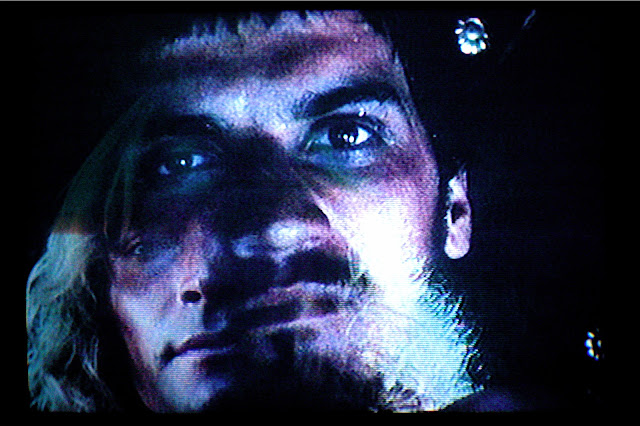
Thanks to Netflix, I finally watched Derek Jarman's Sebastiane last night, a compact 84 minutes of casual male nudity, conjunctural and committed homosexuality, and eroticized proto-Christian masochism. The plot is thin ... we know its broad lines going in, after all, so in that sense this movie is about the eloquence of the telling not the mystery of the outcome, using the terms of Kenneth Burke which I discussed with reference to McCabe and Mrs. Miller: "We cannot take a recurrent pleasure in the new (in information) but we can in the natural (in form)" ... the key word is recurrent, we cannot enjoy something again and again when it is focussed on the new rather than on the style or the form.
So let us start by looking at this film as form, not as plot ... as natural in the sense of the action occurring "as if" it does not need an audience rather than as openly contrived for a defined audience whose ignorance of the outcome and desire for entertainment is the force behind not merely the narrative but the fact of the film itself. What is that silly runnaway bus film with Keanu Reeves ... that sort of film is made with the audience in the foreground. Sebastian makes the audience squirm because it does not know if it is supposed to be present.
This seems funny in the first place because of the unflagging eroticism of the film from beginning to end. The first scene is a bacchanal in presense of Diocletian, the pagan emperor who unleashed the last major persecution of Christians before Constantine's decree of tolerance in 313. The ultimately cruel Maximus, one of those coarse jackasses who populate every workplace in history, tells us that he next saw the sublimely sexy and obviously homosexual Sebastian at an outpost to which both were assigned not knowing why. The bacchanal serves only to situate us where we do not belong, to remind us of the mythology of the Christian writing of history and to establish that the auteur sees no there there. It is an empty device, perhaps essential to reminding us that we do not need to be there, but empty in the sense that it does not matter to plot or to us, the audience for whom the author has no time.
Cut to a stone fortress, a rocky desert, an empty scene in which only the nearly always nearly nude soldiers appear. Except for the initial bacchanal, nudity is as natural and unaffected as the rocks in the desert in which Sebastian and his comrades are posted. They fight, and Sebastian refuses to fight. They gambol, and they make crude sexual insults. Male love appears without narrative motivation, as natural as the spashing water in the long, strangely clean scene of wet intercourse between serenely beautiful Anthony and Adrian until they are called away by Severus, the commander in the sun, who wants them to hurt the reluctant and homoerotically charged Sebastian. This is where we first see in its full articulation the play betwen the unsatisfied and lustful sadist ... Severus ... and the passive masochist, the Christian Sebastian. The commander stakes him spread-eagled in the blazing sun rather than raping him.
Christianity is the oddity, here, though it is certainly noble or rare or at least as refined and sublime as the long wrassle in the water. Rape too is natural, like the hot sun, burning, unpleasant, but known and inevitable.
Why is Sebastian a Christian? Why does he never mention Jesus by name? He refers to him as sublimely beautiful, as more beautiful than Adonis, as if he has substituted the unavailable beauty of the invisible unnamed Jesus for the pressing, insistent and ready-to-go beauty of Severus ... as if the new erotic god who cannot be touched supersedes the old gods whose worship always entailed touch and pleasure. Is Christianity, then, nothing more than frustration, the weakness of a character facing his own sensuality who transforms himself so that he has the strength to resist urges, pleasures? Why is Sebastian more sublime than the lovers in the water? Is it because he allows Severus to hurt him while the lovers allow Severus to bully them?
What is at work here is what I like to call the pretense of unselfconsciousness ... it is "as if" we would not notice when things turn into their opposite. You see, and there is no way around this in the film, Sebastian is as gay as anybody else, as wrapped up in his sensuality and his ability to allure as any of them. But he has slyly turned himself into his opposite. He is a gay man whose erotic force has reversed itself so that it is directed not toward the physical men who surround and desire him, but toward an imaginary figure whom he associates with the Sun. He frustrates his willing rapist, Severus, to the point where he can be martyred. And we are not supposed to notice; we are invited to pretend to feel the sorrow of his loss.
Jarman captured an essential fact of pre-Constantine Christianity, that it served in its history to metamorphose the fulminating movements of spritual and emotional change that roiled through Roman life in the second and third centuries, to transform them drip by drip back ino the empire. It took on the cults, overwhelmed them, and made them temporarily into a rebellious if unarmed Christianity, all the better to reharness them after Constantine to empire and dominance. Now, there is a teleology here ... that is, I am implying that those who operated before Constantine knew that he would follow, and this is false ... but Jarman argues from after the fact. His pretense of unselfconsciousness works because he knows what happened, and he allows Sebastian to represent in his martyrdom not the victory of Chrstianity but the defeat of the erotic.
The climax of the film for me is the torture scene in which Sebastian, tied arms over his head is pinched and struck and threatened and hurt by a Severus who ends up being impotent ... the impotence not apparent, but obvious by the fact that he does not rape his prisoner. Masochism triumphant, sadism humbled. Then the soldiers sitting around apparently torturing someone (I think I missed something here because I cannot identify for you the one with the crown of thorns and the wound in his side that the soldiers were hurting) and they are called ... "Sebastian is to be killed."
The execution by arrows is quiet, slow, the pain is on the face. He does not seem to die. The penetration hovers been life giving and film ending. He is an object of desire, penetrated, strung up, inaccessible, unavoidable. It is difficult watching this to distinguish between pleasure and pain. Is that what Christianity was? Did the martyr merely compress all the ecstasy into one auto da fe?
The film ends, and Sebastian is still an erotic object. The patron saint of gay men.
I will try to return to some of these themes in the next few days. I have been reading an essay on Hellenism and Heresy that dovetails nicely. Another weird connection is this ... Severus reminded me of the hippie who rejected me in Yellow Springs. That is a little juxtaposition and reversal.
Other posts on Sebastiane:
Evocative Vocative Disambiguation
More Thoughts on Sebastian
Both images from my TV, the top overlays Sebastian on Severus, the bottom is Severus.
Wednesday, June 06, 2007
Redundancy and Relevance

Fudging on what to write about tonight. I have a post in my head about Horses and Peoples in relation to the erudite arguments of Robert Bartlett in his The Making of Europe, but after a long day of finagling with text at my job at MRU, I do not know that my perorations would be sufficiently directional. So I am going to take a shot at a little non-directional juxtaposition and reversal ... tugging at two ideas until they are side by side and then seeing if they will run away from each other.
I edit the course catalog at MRU. Since I started this ... I am on my seventh course catalog ... I have looked at a lot of course catalogs, and I unashamedly believe that ours is the best. It is a tight work, heavy in content, and as light in redundancy as I can possibly make it. What I have learned more than anything else in this job is how to detect even the tiniest and most hidden case of redundancy.
Academia is filled, not entirely unjustifiably, with redundancy. Let me posit two sources of that propsensity to "say it again, Sam, and again." On the one hand, the enthusiasm for one's subject, the monomaniacal focus that is the necessary concomittant of committed study, means that most redundancy seems more like emphasis than repetition. On the other hand, it is a form of occupational psychosis, to use the terminology of my favorite literary critic Kenneth Burke, in the sense that repetition is the most ready-to-hand technique by which one might draw attention to one's subject in an open marketplace where the meek risk ending up as afterthoughts ... tenured perhaps but living an "as-if" glory in the company of those whose glory is warm and real and remunerative. So repetition arrives for enthusiasm and remains for marketing.
Every time I edit a course description ... and edit them we do ... I come face to face with this occupational enthusiasm. Now, I argue that a course catalog must speak in a flat, measured, and authoritative voice, and to emphasize anything, to repeat anything that can as readily be said once, is to favor one thing over another, not to mention squander our charge for density of content. So redundancy ... so fertile in argument and enthusiasm, so essential to speech and drama and persuasion ... is our enemy.
Today, I confronted a particularly woolly description. I say "woolly" because it arrived as a tightly woven argument, and my job is to extract a list of topics. I have no idea what this prof will think when he sees the results of my jackhammering, but I offer that it was a delicate and humane jackhammer, the sort of thing a sculptor who works in concrete and steel would wield when confronted with a giant roll of coiled steel cable. Does that make sense? Maybe the editor should edit himself!
That said, I loved the course. An editor is like a dentist ... it doesn't matter whose teeth you are drilling, the job is to make them choppers, not to prefer one set over another. So like this course or not, I did my duty and this is one line from it: "How antithetical responses provoked by crisis demonstrate literature's capacity to produce and sustain apparently untenable contradictions; how this paradoxically may make literature a conciliatory force." Wow ... wish I'd said that myself; it is precisely the kind of contradiction and reversal that fascinates me in everything.
But the original was unashamedly more formidable, more armored, more predatory. It was one of those tightly bound up literary arguments that have made literary studies the object of ribaldry among the other disciplines not just because they are impenetrable but more so because they are gamefully repulsive ... that is, designed to repel the uninitiated with a cackle rather than embrace the novice with blandishments, let alone involve other academics in the particular arguments that criticism can generate and propel.
For the literary academic, the repellent or predatory argument has often become more attractive when it functions as collapsed interplay of public sadism and masochism. Yes, there is a sort of masochism here ... which is to say the masochism of the sadist who would hurt himself for the sheer joy of both ouching aloud and at the same time being the one who caused the ouch. Ouch! For in this little gem of an argument which I flattened into the phrase above, the author simultaneously shows his ability to hurt himself and to draw those who recognize this auto da fe to him, even as the bulk of the actual readers slide on by, neither repulsed nor attracted but distinguishing themselves by their disinterest.
Any redundancy here functions to intensify this public display. In academic literary critical circles, redundancy has assumed an arrogance of isolation. (At some point, I will argue that literary criticism needs to abandon this conceit not only for survival but for its own art.)
Okay ... relevance. Repetition, with which we started, is a cry for relevance, whether as enthusiasm or as something that should be consumed/marketed. Redundancy as enthusiasm repeats its theme so as, by juxtaposing itself to itself, to make itself bigger and thereby to attract and not to repel, and thereby to imply that it is relevant to the reader/listerner/observer/consumer. Redundancy as marketing, as occupational psychosis, is more like a peacock wherein the splendor is assumed to be the proof of the relevance. Relevance, in this sense, is a little abstract ... not relevance to something else, but a general, intransitive relevance which assumes a referrent without naming or specifying or delimiting it. But the problem with boundlessness in describing a phenomenon is that the lack of boundaries allows one to substitute anything ... I like to call this a "zero divider" because any result is possible when you divide by zero. So the intransitive notion of relevance can thereby come to mean that something is relevant only if in the narrowest sense it is relevant to "me" and who I define myself as. This is what relevance has come to mean in education (deferring a discussion of the degree to which this phenomenon matches a broader social issue) ... a topic is "relevant" if it can be demonstrated to touch the observer's self-identification.
By repeating and repeating, and by saying again and again that this is you, this is you, the topic becomes relevant, instransitively, for any observer who is thus simultaneously singled out and reduced to identity.
And so the oddity of our course description is that any redundancy in its tightly bound argument worked to isolate itself enthusiastically to that tiny set of students who could posit their intellectual identity in it. But at the same point, it had eschewed any larger marketing that might integrate it or insinuate it into a broader intellectual market. It turned both redundancy and relevance on their heads, but as with most of the present highly isolated literary critical impulses, it takes no advantage of that.
In editing that line, I sought, professionally and not ideologically, to open it to a less restricted audience and this flatness has the inadvertent effect of stripping off its isolation and suggesting that literary contemplation of paradox and antithesis is an essential tool that literary work can provide to other disciplines. I think that Bartlett, with whom I began this peroration, succeeded in that in one part of his book, and perhaps I can try to explain that tomorrow.
Hmmmm ... not sure that I have made my case, but I will leave it at this, and try to come back to the juxtaposition of redundancy and relevance on some other occasion from a different angle. (I want to add as a note to myself that the course description above in its unedited state started with a straw man argument; I saw this as a move to credential the course both as ironic and dialectical. Not the subject of this post, but this double credentialing is not uncommon in our discipline, both to good and ill effect.)
Photo by Arod.
Monday, August 13, 2007
Half Full Half Empty
Ah, Monday the thirteenth ... blue Monday.
Thinking some more about Hillary and liberal defeatism. There is a certain poignancy in such thoughts on this day when Karl Rove announces his strategic retreat to the private sector of cashing in. No surprise, I think he is one of the lowest curs ever to occupy an office in the White House, and that takes some doing.
But "no surprise" in another sense ... a Karl Rove presents no surprises. Conservatives, by and large, don't present a lot of surprises. That is in the nature of what Kenneth Burke calls an "occupational psychosis." The affect of the conservative is to defend the indefensible in the sense that hanging on to the past, on any level, tends to be a fruitless occupation in the long run. But conservatives have not been conservative on that level for some time, and the Dubya-ites are vastly more radical than they are conservative. So their method is to snow the out-there conservatives who support them in order to advance a radical agenda. Same methods ... no surprises ... just lie your way to the bank, and keep a big smug smile up front and center.
Doesn't work that way for liberals. What I called liberal defeatism in yesterday's post is as often as not simply balancing the half empty and the half full ... looking at the upside and the downside at the same time.
Now there are plenty of kneejerk liberals. I remember an episode in the 70s when I was in gay liberation. We had managed to sponsor a couple of showings of Word is Out, a pioneering film in which a variety of men and women talked about their lives in the closet and their experience of coming out. We showed it at the Vancouver Art Galley on Georgia Street (not in the same location as now). It was three blocks from my apartment. We had a gala opening night, and then I skipped the second viewing the following night until I got a call at home that a bunch of christians had shown up to protest carrying signs mounted on 2 x 4's. I raced down ... the moment is burned in my mind because I knew the young pastor who led this group from other events, and as I walked by him, I said, "Here spreading hate again, are ya?" I think he was taken aback. But the point of this story was that outside the ring of these micro-fascists was a bunch of PC dykes of my acquaintance who did not want to cross the picket line. I had to convince them that these were our enemies. They never bothered to read the signs or anything rational like that. They saw a picket line, they honored it.
But all that is an aside however annoying the pc-er's (p-seers, I like to call them) may be, their influence on politics is at an ebb in these days, notwithstanding the firey idiocy of Chris Daly, San Francisco supervisor ... gotta leave that to another occasion.
The problem in the larger zone of liberalism is that we are occupationally prone to look at both sides of the coin. So in the dinner debate I described yesterday, I was accusing my interlocutors of being pointlessly pessimistic, but half an hour later I was rambling on about how the housing crash is going to bring us all to our knees. So, I was clearly violating my own pronunciamento. This is not uncommon. And it is not entirely without justification. I think one has to be unusually blind ... or a Republican ... not to realize that the sum of the issues confronting our species is more daunting than anything we have ever faced. The colossal imminent climate catastrophes are looming even as we have dragged the most volatile parts of the world to the edge of a holocaust. And the economy is puffed up on steroids, unusustainably.
But, then again, a couple of days ago I was bemoaning the bad time we give to the seemingly steroidal Barry Bonds.
No clarity, no simplicity, no one answer. That is the curse of liberalism.
So at bottom, increasingly as I get older and more cautious, I take solace in what might ameliorate things ... in the art of the possible. And that is why I have begun more and more to be convinced that Hillary is the best answer out there. She has the best shot to get elected, in my view, and she has the best shot of not self-destructing in some kind of earnest Jimmy-Carter-meltdown, or, on the other hand, getting snowed by reactionary thought like the hapless Lyndon Johnson. The latter, alas, is more likely. I think she is also the one who understands best what a paradigm shift is, having lived through the one that her husband created for eight too-brief years. No guarantees, but she is the best shot.
Enough of this ramble ... not all that sharp a ramble ... but a ramble nonetheless.


